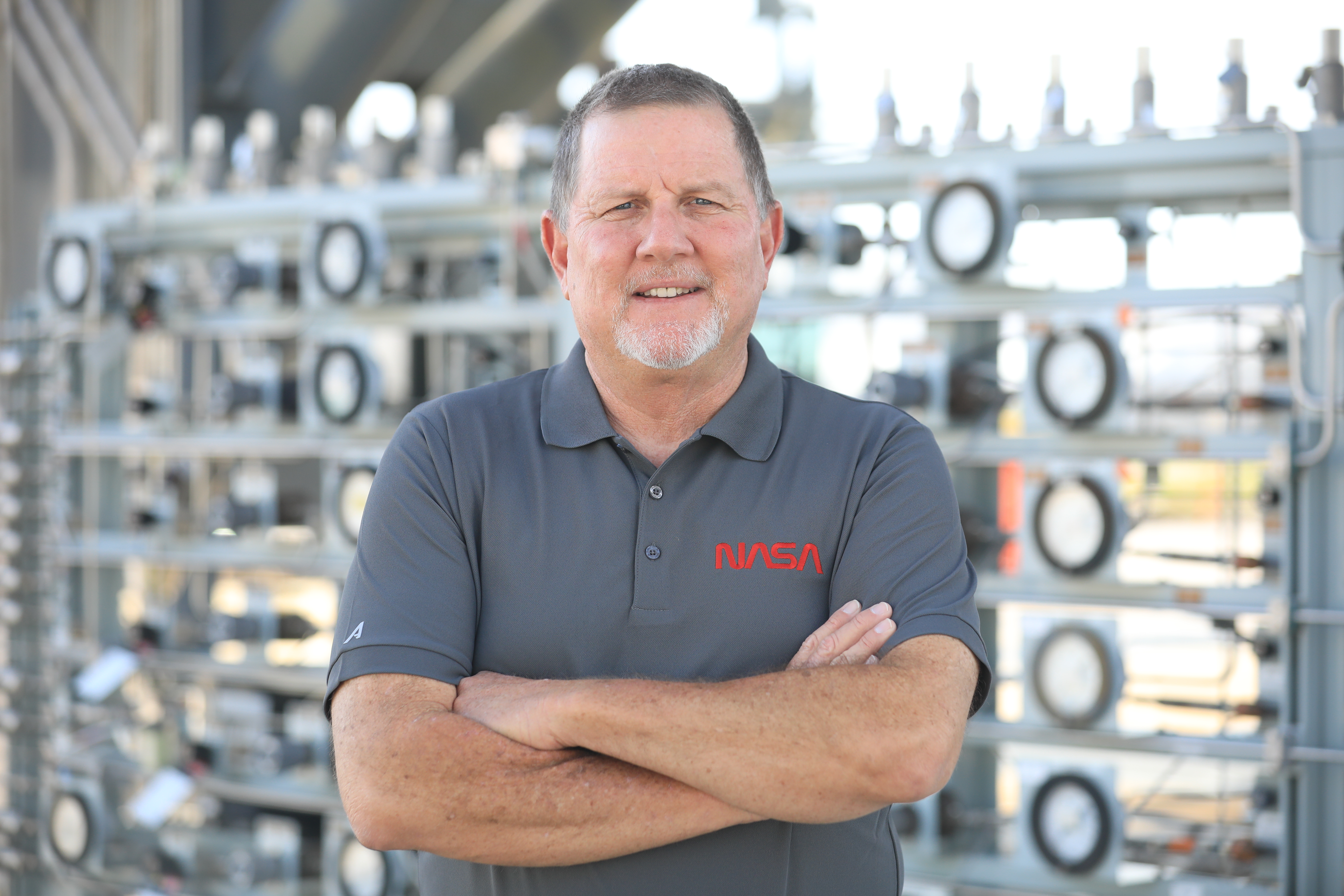
Kenny Heckle grew up in Orlando, just west of NASA’s Kennedy Space Center in Florida. An 80s child, he comes from a long line of union pipefitters and fabricators.
Heckle recalls the day 42 years ago at KARS Park, which is a NASA Exchange–run recreation area for the agency’s workforce and their guests, when he attended an office party with his father. Heckle had his German Shepherd with him when a man who seemed to be enamored with the canine asked him who he was. “I’m Kenny Heckle, Wayne’s son,” he said. And the man who knew his dad well replied, “Why don’t you work for us (at NASA)?”
Two weeks later, Heckle was working at the center alongside his dad.
Heckle wasn’t a typical new employee. At 19, he already had seven years of mechanical experience, working on his father’s short-track stock cars, building and fabricating parts they needed. He later attended welding school before arriving for his first job as a contractor at NASA Kennedy’s Launch Equipment Test Facility (LETF) in 1984.
Since the 1970s, the LETF has provided NASA a place to safely assess machinery and designs to support launches through a unique set of structures, equipment, and tools to test full-scale umbilicals and release mechanisms.
Today, Heckle serves as the mechanical operations lead at NASA Kennedy’s LETF.
During the past four decades, Heckle has helped numerous NASA programs and commercial partners test their equipment ahead of launch, and in some instances, during and after liftoff. In his early years, his job was to test every umbilical on the launch pad and all the ground support equipment needed for Launch Complex 39A and B, even for Vandenberg Space Force Base in California.
Just two years into his career, Space Shuttle Challenger had a failure of the O-ring seals and broke apart just over a minute into its flight. Heckle remembered watching the catastrophic liftoff that morning, and hearing the broadcaster say Challenger was lost. A couple of weeks later, his team was tasked with helping to figure out what happened.
“You know, there’s always risk with spaceflight,” Heckle said. “But we got so consistent that we didn’t think something like that could happen and it hit hard. But then being able to come back and get the program going again, and being successful, that makes you proud.”
Nearly two decades later, Heckle’s team was asked to help with yet another investigation. After the Colombia accident, Heckle and his team were charged with showing how severe the damage was through their testing, and how to mitigate ice hitting a wing in the future. They spent hours shooting projectiles at thermal tiles, using ultrasonic sensors to track the data.
In recent years, Heckle has helped work on the first two Artemis missions. During the Artemis II wet dress rehearsal, there was a liquid hydrogen leak. Heckle was working long days, troubleshooting and fabricating possible solutions with Kennedy’s Prototype Lab. For Artemis I they had a similar leak, and Heckle’s team developed a process to slow fill the cryogenics and the LETF sent that information to the Artemis I launch team to implement.
During decades of problem-solving, Heckle and most of his team were contractors, having to work through the bureaucracy of working solutions across different contractors, as well as with NASA. On May 4, Heckle and 19 of his teammates applied and became NASA civil servants as part of the administrator’s workforce directive. The work done by the LETF team was deemed a critical capability to NASA’s future, and as such, the work was moved from an outside vendor to civil service, ensuring NASA is staffed and equipped to lead the most complex engineering and operational challenges directly.
The test facility ensures NASA retains the technical readiness, flexibility, and risk mitigation capabilities required for Artemis, SLS (Space Launch System), and future government and commercial missions. As the mechanical operations lead, Heckle has already noticed efficiencies with being able to get work done and securing the supplies needed now the LETF team has joined the civil servant workforce.
“If we continue to work together as a team and not have barriers, I think that will be great for the program moving forward no matter what we’re launching,” Heckle said.