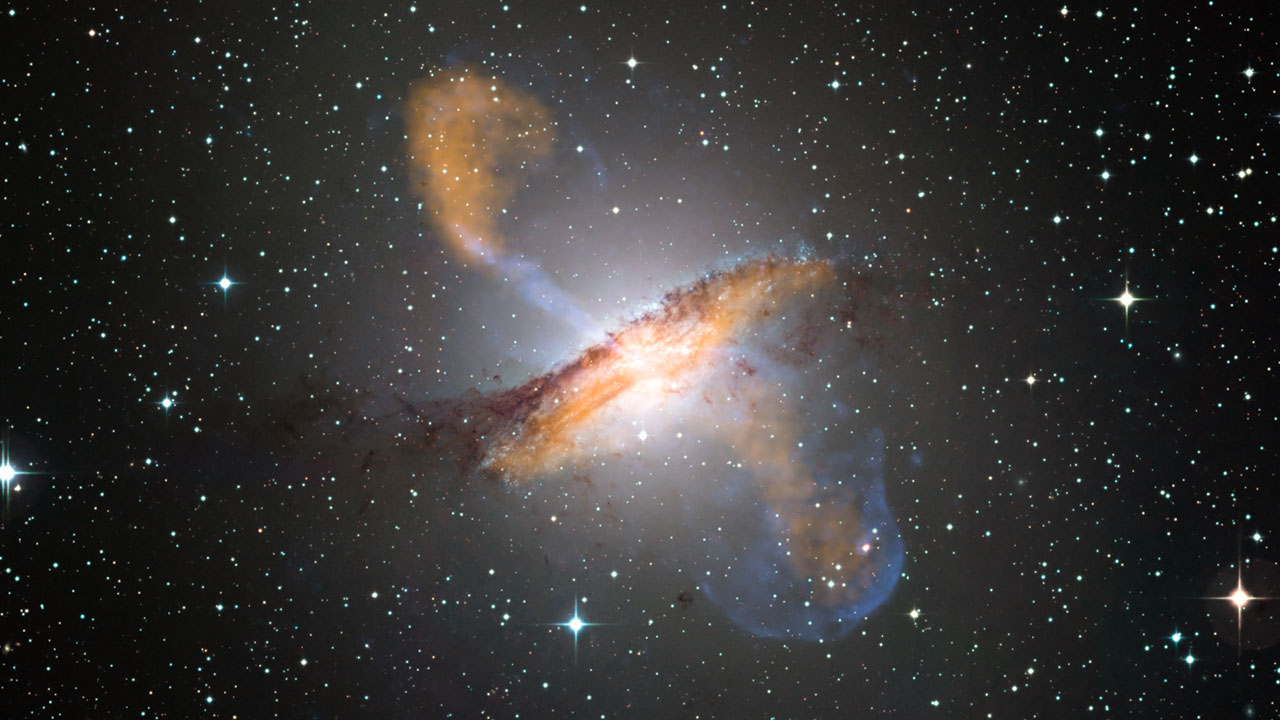
We are thrilled to announce the AGN Dissertation Jamboree! This three-day event will be held from 1–2 pm ET / 10–11 am PT on April 28th, 29th, and 30th. The program (see below) highlights a range of exciting AGN science shaping the future of the field.
We encourage everyone to join us in supporting our early career AGN researchers with your engagement, questions, and feedback.
Dates
28-30 April 2026
1:00pm – 2:00pm ET
10:00am – 11:00am PT
Tuesday, 28 April 2026
A Spatially-Resolved, Multiphase Analysis of AGN-Driven Feedback and Outflows in NGC 3227
Speaker: Julian Falcone (Georgia State University)
Abstract: The advent of high-resolution spectroscopy has allowed us to observe AGN environments in greater detail than ever before. My thesis work focuses on in-depth analyses of the spatially resolved kinematics and mass outflows of the ionized [O III] and cold molecular CO(2-1) gas in the inner 5” (~600 pc) of the nearby Seyfert 1 galaxy NGC 3227. While the majority of studies present a single (i.e., “global”) value for the ionized and molecular mass outflow rates within a given galaxy, our work highlights the necessity of spatially resolved studies to better understand the varying dynamics and physical conditions of the outflowing gas. Under the assumption that the CO(2-1) gas functions as a reservoir which is converted to ionized gas and subsequently evacuated, we have used these outflow rates to create the first spatially resolved estimation of the time over which this evacuation occurs, thereby defining the duration of continuous AGN activity. In this talk, I will discuss observational evidence of feedback in this galaxy, our understanding of how massive amounts of ionized and molecular gas are excavated from the center of this galaxy as a result of the feedback, and what these mass outflows reveal about the timescales over which the AGN is continuously operational.
M31*, M32*, and Sgr A* as “Active” Galactic Nuclei in X-rays
Speaker: Steve DiKerby (Michigan State University)
Abstract: Our understanding of activity near supermassive black holes depends heavily on observations of distant AGN emitting close to the Eddington limit. In addition to this corpus of work, nearby SMBH within the local group can serve as unique laboratories of accretion and variability. The proximity of systems like Sgr A* and M31* allows for detailed X-ray analyses of each SMBH and its environment, expanding our understanding of the diversity of activity in galactic nuclei. I will also discuss how other local galaxies like M32 are the next frontier of the search for the closest low-activity SMBH and how next-generation X-ray observatories will enable further studies of SMBH in our cosmic backyard.
Wednesday, 29 April 2026
Effect of AGN on the ISM of Their Hosts: A Multi-wavelength Perspective
Speaker: Payel Nandi (European Southern Observatory)
Abstract: Active galactic nuclei (AGN), powered by the accretion of matter onto supermassive black holes (SMBHs) at the centres of galaxies, play a crucial role in shaping their host galaxies and the surrounding large-scale environment through feedback processes. AGN feedback is widely invoked in galaxy formation models and simulations to explain the observed correlations between SMBH mass and host galaxy properties. Outflows represent a viable mechanism through which such feedback operates. These outflows, observed across molecular, atomic, and ionised gas phases, have a debated origin but can significantly influence the interstellar medium (ISM) of host galaxies by either suppressing (negative feedback) or enhancing (positive feedback) star formation. While the interaction between radio jets and the ISM is known to regulate star formation in massive galaxies, its role in dwarf galaxies remains largely unexplored. Recent observational evidence of AGN in dwarf galaxies challenges theoretical models that predominantly attribute feedback in such systems to supernovae. In this thesis, we present a systematic investigation of a sample of AGN aimed at addressing: (a) the physical mechanisms that trigger outflows, (b) the impact of AGN activity on star formation in host galaxies, and (c) the incidence and nature of AGN feedback in a dwarf galaxy powered by an intermediate-mass black hole. To achieve this, we utilise multi-wavelength data including X-ray imaging from the Chandra X-ray Observatory, ultraviolet observations from the Ultra-Violet Imaging Telescope (UVIT) aboard AstroSat, optical imaging from the Hubble Space Telescope, radio data from the Very Large Array, spatially resolved optical and infrared spectroscopy from Gemini and MaNGA, and sub-millimetre observations from ALMA. Our results show that: (a) ionised outflows are prevalent across all classes of AGN, (b) radiation from the AGN is the primary driver of these outflows, with radio jets playing a secondary role in enhancing gas kinematics, (c) star formation is enhanced in the central regions of galaxies due to AGN activity, (d) we report the first evidence of jet–ISM interaction on scales of ~10 parsecs in the dwarf AGN NGC 4395, and (e) both AGN induced positive feedback at 100pc scale of NGC 4395.
Co-Evolution of SMBH and Galaxies From Cosmic Noon to the Present Day
Speaker: Yang Sun (University of Arizona)
Abstract: The tight correlation between supermassive black holes (SMBHs) and their host galaxies reveals a fundamental link between their evolutionary path, yet its origin and underlying mechanisms remain elusive. In this talk, I will present my recent efforts to constrain SMBH–galaxy co-evolution across cosmic time. Using deep JWST observations and forward-modeling simulations that account for observational biases, I found that the local MBH-M* relation was already in place by z~4. At higher redshifts, however, while luminous quasars still follow the local relation, faint JWST AGNs at z~ 6 appear significantly over massive, suggesting distinct early growth pathways. Next, I will introduce my recent studies on AGN feedback, one of the physical mechanisms linking SMBH and galaxy growth, especially its impact on early galaxy quenching by conducting a census of Na D–traced neutral outflows across the SFR–M* diagram at 1 < z < 4. The results reveal that AGN feedback is widespread in massive quiescent galaxies at cosmic noon, underscoring its key role in driving the main epoch of galaxy quenching in the Universe.
Thursday, 30 April 2026
A Complete Census of the Properties of Radio-Quiet AGN in the Local Universe: Implications for Black Holes and AGN Feedback
Speaker: Macon Magno (Texas A&M University)
Abstract: Radio-quiet AGN are by far the most common variety in the local universe, and therefore, are the most likely primary means by which black holes grow and a major factor in galaxy evolution at z < 0.1. We have completed a high-frequency, high-resolution VLA imaging survey of 231 radio-quiet X-ray-selected AGN from the Swift-BAT survey with only 4 non-detections, a 98% detection fraction. Our sample spans 4 orders of magnitude in black hole mass and X-ray luminosity, covering a wide range of host galaxy properties. The radio morphologies are diverse; about evenly divided between compact on ~100 pc scales and extended outflows or star formation on kpc scales. The radio to X-ray luminosity ratios of our sample are similar to the ratios derived for coronally active stars and inconsistent with radio-loud, jetted AGN. Extended radio emission in our sample tended to be consistent with the expectation for star-formation based on IR-derived star formation rates. To determine the extent to which the kiloparsec-scale outflows discovered in our sample are affecting the host ISM, we hypothesize that water maser emission will result in regions of dense interstellar gas shocked by AGN outflows, analogous to what happens in Milky Way star-forming regions. We observed 5 water maser emitting galaxies with the VLA, and found that 2 of the sources show clear signs of water maser emission arising from AGN outflows interacting with the ISM, the first such discovery in AGN. Finally, we investigate the spectroscopic properties of our sample. We noticed many of our sources had a high-frequency excess, a significant deviation from the typical assumed power law when extrapolating from data from lower frequencies. We have gathered all public data from radio surveys and the archives of the VLA and ALMA to construct highly complete radio SEDs for the full sample, the largest compilation of detailed SEDs for radio-quiet AGN. Monte-Carlo modeling suggests that simple power laws in radio spectral space are very rare, and that SEDs are quite diverse, contrary to decades of expectation based on sparse SEDs. Overall, our sample represents nearby analogs of distant AGN at the peak of black hole growth, and thus the high detection fraction in our work has important implications for future high frequency AGN radio surveys with the next generation VLA or Square Kilometre Array, both of which should detect large fractions of more distant AGN.
Multi-band Studies of HBL Blazars with Space-Based Telescopes
Speaker: P. U. Devanand (Aryabhatta Research Institute of Observational Sciences)
Abstract: High-energy-peaked BL Lac objects (HBLs) have their synchrotron peaks in the UV to soft X-ray band, making X-ray observations especially useful for probing the high-energy particle population in relativistic jets near the central supermassive black hole. In this work, we present an extensive X-ray flux and spectral variability study of TeV-detected HBLs using archival data from the EPIC-pn camera onboard XMM-Newton. The study combines three complementary investigations: an intraday flux variability study of 10 TeV HBLs using 25 observations, a spectral study of 13 TeV HBLs using 54 observations, and a source-specific spectral study of PG 1553+113 using 30 observations. The intraday variability analysis was carried out in the soft (0.3–2.0 keV), hard (2.0–10 keV), and total (0.3–10 keV) energy bands. We detected intraday variability in 15 of the 25 observations, spread across seven sources. Hardness-ratio analysis showed that most flux variations were not accompanied by significant spectral changes, indicating largely achromatic variability. Power spectral density analysis of the variable light curves gave slopes in the range 1.1–2.9, and minimum variability timescales were used to constrain the magnetic field strength, emission-region size, and Lorentz factor of the radiating electrons. Spectral analysis over 0.6–10 keV showed that most spectra are well described by convex log-parabolic or simple power-law models, consistent with synchrotron-dominated emission. A few observations also showed evidence for an additional inverse Compton component which is rare for HBLs.
Meeting Connection
Zoom Registration (single registration covers all days):
https://zoom.us/j/97689874465?pwd=XZNUqr19oopa1LfD7hgln1aQ2vbnT2.1
Connection details will be sent by email after registration.