Adsence Adsence

Catalog Page for PIA25738

Catalog Page for PIA25738

Figure A This photomontage shows each of the sample tubes shortly after they were deposited onto the surface by NASA’s Perseverance Mars rover, as viewed by the WATSON (Wide Angle Topographic Sensor for Operations and eEngineering) camera on the end of the rover’s 7-foot-long ( 2-meter-long) robotic arm. Shown, from left, are “Malay,” “Mageik,” […]

Catalog Page for PIA25738 Read More »

Catalog Page for PIA25802

Catalog Page for PIA25802

Context image This VIS image is located in Kaiser Crater and shows several regions of sand dunes located on the southern part of the crater floor. The crater floor is visible between the dunes, indicating that there is a limited sand supply creating the dunes. These dunes are composed of basaltic sand that has

Catalog Page for PIA25802 Read More »

Catalog Page for PIA25801

Catalog Page for PIA25801

Context image Located between the lava plains of Daedalia Planum and Solis Planum, Claritas Fossae is a graben-filled highland. Graben are formed by tectonic activity, where extensional forces stretch the surface allowing blocks of material to slide down between paired faults. These linear grabens are termed fossae. This region of Mars had very active

Catalog Page for PIA25801 Read More »

Catalog Page for PIA25770

Catalog Page for PIA25770

Context image Today’s VIS image shows a small portion of the immense lava flows that originated from Arsia Mons. Arsia Mons is the southernmost of the three large aligned volcanoes in the Tharsis region. Arsia Mons’ last eruption was 10s of million years ago. The different surface textures are created by differences in the

Catalog Page for PIA25770 Read More »

Catalog Page for PIA25564

Catalog Page for PIA25564

Figure 1 The magnitude 7.8 and 7.5 earthquakes that struck southern Turkey and western Syria on February 6, 2023, caused widespread destruction in both countries. The initial, stronger earthquake emanated from a fault 11 miles (18 kilometers) below the surface. The shallow depth meant the earthquake produced violent shaking that affected areas hundreds of

Catalog Page for PIA25564 Read More »

Catalog Page for PIA25628

Catalog Page for PIA25628

Figure A Figure B Figure CClick on images for larger versions This composite image of the Sun includes high-energy X-ray data from NASA’s Nuclear Spectroscopic Telescope Array (NuSTAR) shown in blue; lower energy X-ray data from the X-ray Telescope (XRT) on the Japanese Aerospace Exploration Agency’s Hinode mission shown in green; and ultraviolet light

Catalog Page for PIA25628 Read More »

Catalog Page for PIA25769

Catalog Page for PIA25769

Context image The Ius and Tithonium Chasmata are located at the western end of Valles Marineris. Tithonium Chasma is north of Ius Chasma. Valles Marineris is over 4000 kilometers long (2495 miles), almost as wide as the United States. Ius Chasma is almost 840 kilometers long (522 miles), 120 kilometers wide and over 8

Catalog Page for PIA25769 Read More »

Catalog Page for PIA25734

Catalog Page for PIA25734

Figure A NASA’s Curiosity Mars rover captured this image of rhythmic rock layers with a repetitive pattern in their spacing and thickness. The pattern might have been caused by weather or climate cycles occurring while the sediment layers were being deposited, such as dust storms happening at regular intervals in the ancient past. This

Catalog Page for PIA25734 Read More »

Catalog Page for PIA25733

Catalog Page for PIA25733

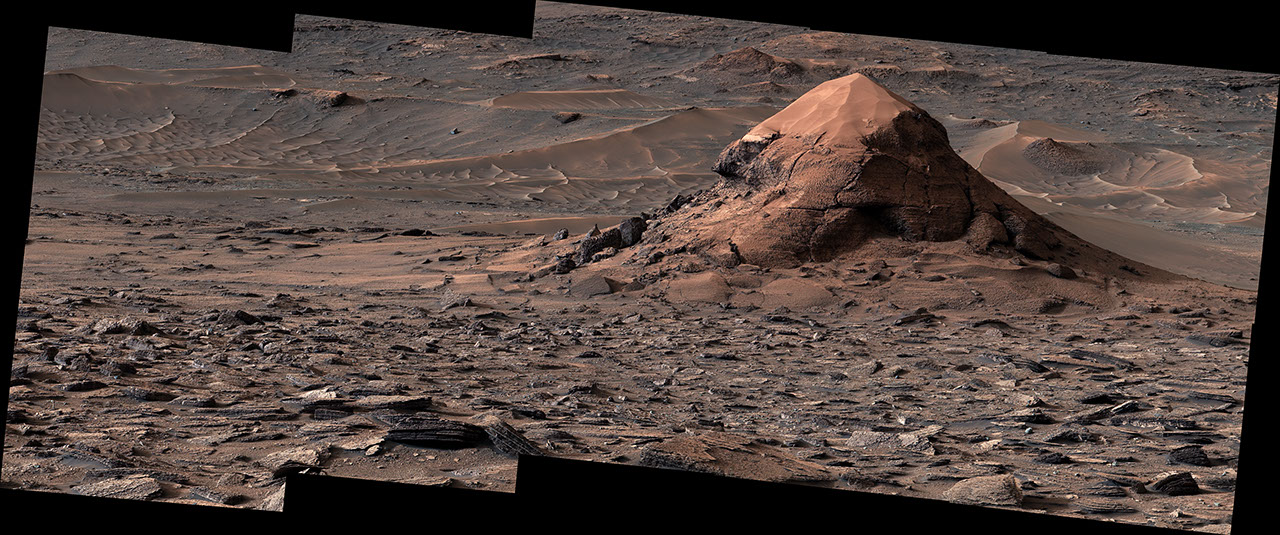
Figure A NASA’s Curiosity Mars rover used its Mastcam to capture this mosaic of Gediz Vallis on Nov. 7, 2022, the 3,646th Martian day, or sol, of the mission. In the center of the valley in this image is a pile of boulders and debris that may have been swept there by flowing water

Catalog Page for PIA25733 Read More »