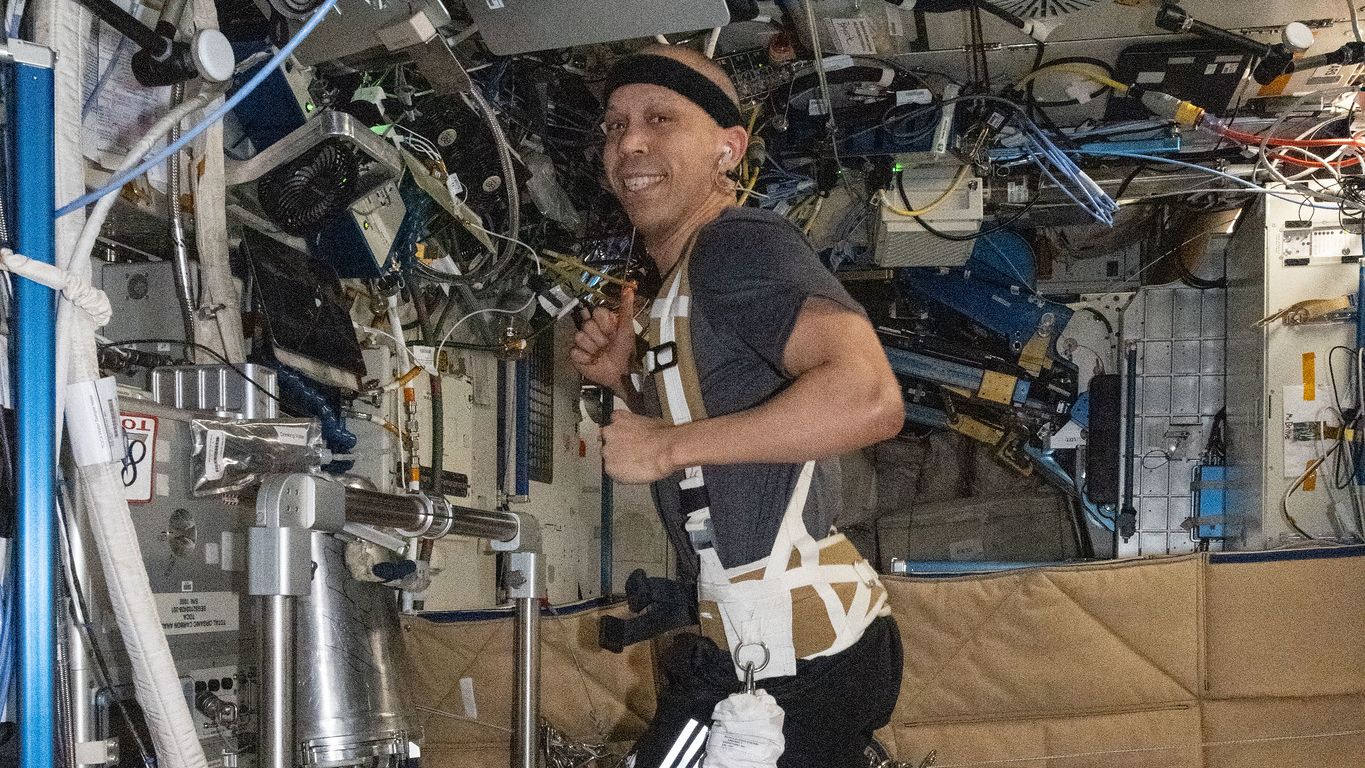
Health checks and CubeSat hardware maintenance were the prime research objectives aboard the International Space Station on Wednesday. The Expedition 74 crew members also stowed spacewalking gear, transferred cargo, and checked seats in a Soyuz spacecraft.
Continuous health monitoring in space helps doctors keep crews safe while living in weightlessness for months at a time and informs researchers how the human body adapts to microgravity. The astronauts often wear a variety of sensors comfortably measuring vital signs throughout their shift. Advanced portable health gear and standard medical imaging hardware on the orbital outpost can analyze an astronaut’s blood samples, DNA, eyes, and more, then downlink the results to doctors on Earth.
The long-running CIPHER suite of 14 human research studies collects a crew member’s mental and physical health data before, during, and after mission. The multi-year investigation provides doctors a deeper understanding of the effects of living in space long term and helps promote an astronaut’s safety and health to ensure mission success. NASA flight engineer Chris Williams contributed to a portion of that investigation collecting his blood and urine samples using medical tools adapted for microgravity. Next, he processed his samples with a centrifuge and small tubes then stowed the biological specimens in a science freezer for preservation and later analysis.
Williams, in between his blood work and urinalysis, worked inside the Quest airlock with NASA flight engineer Jessica Meir continuing to stow the tools that they used during a spacewalk to repair the Canadarm2 robotic arm on June 30. Williams also joined Roscosmos cosmonauts Sergey Kud-Sverchkov and Sergei Mikaev and checked the custom-fit seat liners they will sit in when they ride back to Earth inside the Soyuz MS-28 spacecraft at the end of the month. Meir finished her shift inside the Unity module replacing brackets and panels to make room for life support equipment.
NASA flight engineer Jack Hathaway retrieved the NanoRacks CubeSat deployer from inside the Kibo laboratory module’s airlock then uninstalled it from Kibo’s multipurpose experiment platform. Several days earlier, the device deployed tiny satellites designed by university students for a variety of communications and technology investigations into Earth orbit. Hathaway then entered the Permanent Multipurpose Module and cleaned up cargo.
ESA (European Space Agency) flight engineer Sophie Adenot began her shift transferring cargo in and out of the Cygnus XL cargo spacecraft with assistance from Meir. Next, she set up eye imaging hardware then powered on the Ultrasound 2 device and checked its video connections. Adenot, at the end of her shift, collected airflow measurements in the station’s modules and inspected ventilation system components.
Kud-Sverchkov and Sergei Mikaev participated in eye checks using the same gear Adenot set up earlier. The duo also collected their blood and saliva samples for analysis before staging cargo to be packed later inside the Souz MS-28.
Roscosmos flight engineer Andrey Fedyaev spent his shift swapping out radiation detection gear, measuring his blood pressure with a series of arm, wrist, and finger cuffs, then inspecting laptop computers inside the Nauka science module.
Learn more about station activities by following the space station blog, @space_station on X, as well as the ISS Facebook and ISS Instagram accounts.
Get the latest from NASA delivered every week. Subscribe here.