As NASA advances technology for long-term exploration of the Moon and missions to Mars, one of the most challenging obstacles is propulsion, specifically, how to launch astronauts off the Martian surface for their journey home. Traditional rocket engines require massive amounts of fuel or propellant. Propellant is heavy and takes up a lot of room, which makes it challenging and expensive to design and transport for longer missions. Enabling this technology, will aid in NASA’s ambitious exploration goals.
Enter Rotating Detonation Rocket Engines (RDREs), a promising propulsion technology with the potential to significantly improve efficiency. First conceived in the 1960s, RDREs have only recently become manufacturable thanks to advancements in additive manufacturing and high-performance metallic materials. Unlike traditional engines that burn fuel through subsonic deflagration (slow-moving burn), RDREs harness supersonic detonation waves that continuously rotate inside the combustion chamber. This radical approach delivers higher potential efficiency gains while producing a more compact engine compared to traditional designs in the same thrust class. Smaller, lighter, and more efficient, RDREs have all the makings of a game changer for missions to the Moon and Mars.
NASA’s Marshall Space Flight Center in Huntsville, Alabama, in partnership with NASA’s Glenn Research Center in Cleveland, Ohio, is turning this promising technology into reality. The team is developing a next-generation RDRE system: a 10,000-pound-force thrust class engine powered by liquid oxygen and liquid methane in a pump-fed configuration.
Featured Video
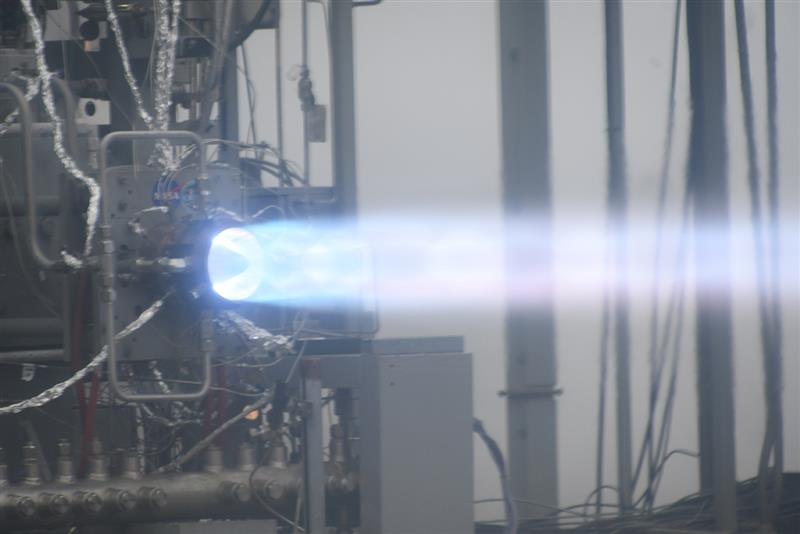
NASA’s 3D-printed Rotating Detonation Rocket Engine Test
Test stand video captured at NASA’s Marshall Space Flight Center in Huntsville, Alabama, shows ignition of a full-scale Rotating Detonation Rocket Engine combustor, which was fired for a record 251 seconds and achieved more than 5,800 pounds of thrust.
This is a ground demonstration. Following the InRoDES project will be a test under vacuum, then transfer of the technology to industry for their own individual missions.
Some of the technology was developed through NASA’s Small Business Innovation Research program, Early Career Initiative, and Announcement of Collaborative Opportunity.
Timeline
December 2025 – Engineers at NASA’s Marshall Space Flight Center in Huntsville, Alabama, successfully test fired a rotating detonation thrust chamber assembly. The engine combustor fired for just over 340 seconds, allowing teams to successfully test the initial thrust chamber assembly configuration for the first time as part of the Integrated Rotating Detonation Engine System (InRoDES) project. The InRoDES engine is a lightweight propulsion system that uses liquid methane and liquid oxygen to power its innovative rotating detonation combustion chamber. Capable of 5,000 to 10,000 pounds of thrust, InRoDES is a planetary lander engine.
The thrust chamber assembly tested September 2025 uses detonation combustion to burn liquid propellants, creating the rocket engine’s thrust. Such technologies can increase efficiency and enhance capabilities for long-duration spaceflight helping enable technology solutions as NASA prepares to send astronauts to the Moon and pave the way to human exploration on Mars.
Additional Information

2025 AAS Conference Paper
NASA’s Rotating Detonation Rocket Engine Development
Featured Podcast
Houston We Have a Podcast
From Earth orbit to the Moon and Mars, explore the world of human spaceflight with NASA each week on the official podcast of the Johnson Space Center in Houston, Texas. Listen to in-depth conversations with the astronauts, scientists and engineers who make it possible.
Keep Exploring