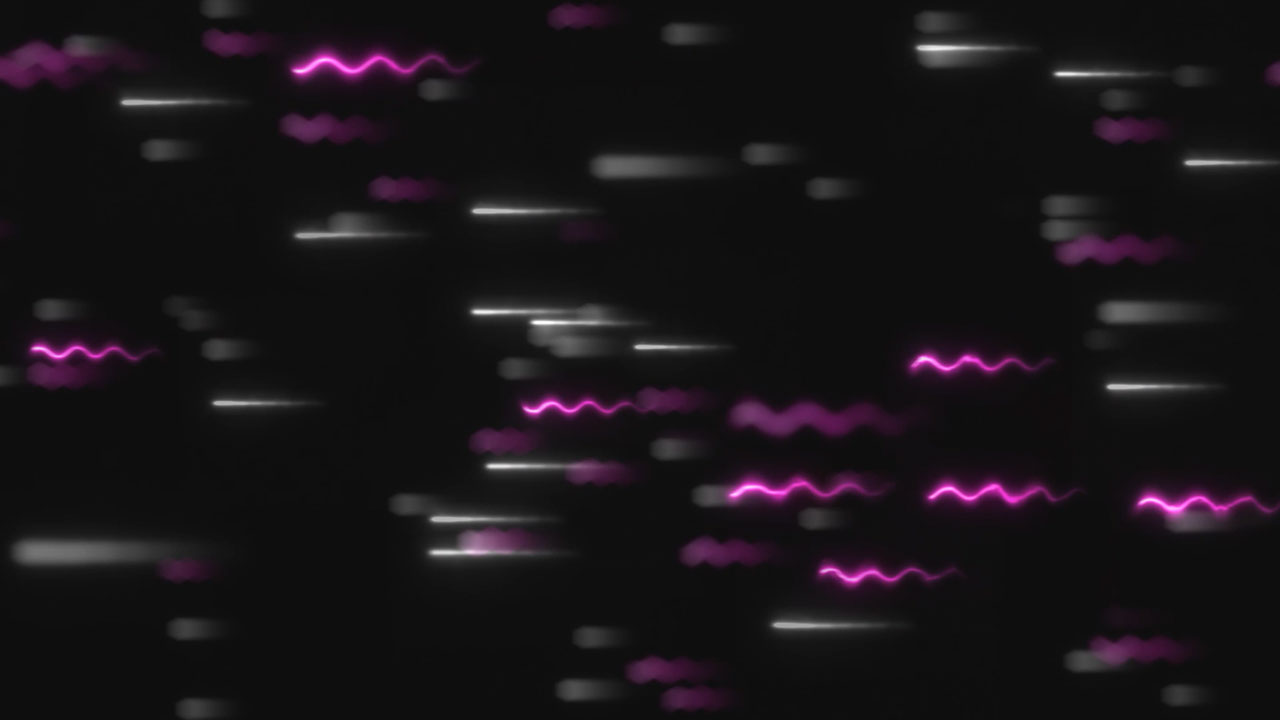
This second, as you’re reading these words, trillions of tiny particles are hurtling toward you! No, you don’t need to brace yourself. They’re passing through you right now. And now. And now. These particles are called neutrinos, and they’re both everywhere in the cosmos and also extremely hard to find.
Neutrinos are fundamental particles, like electrons, so they can’t be broken down into smaller parts. They also outnumber all the atoms in the universe. (Atoms are made up of electrons, protons, and neutrons. Protons and neutrons are made of quarks.) The only thing that outnumbers neutrinos are all the light waves left over from the birth of the universe!
Physicist Wolfgang Pauli proposed the existence of the neutrino, nearly a century ago. Enrico Fermi coined the name, which means “little neutral one” in Italian, because these particles have no electrical charge and nearly no mass.
Despite how many there are, neutrinos are hard to study. They travel at almost the speed of light and rarely interact with other matter. Out of the universe’s four forces, ghostly neutrinos are only affected by gravity and the weak force. The weak force is about 10,000 times weaker than the electromagnetic force, which affects electrically charged particles. Because neutrinos carry no charge, move almost as fast as light, and don’t interact easily with other matter, they can escape some bizarre and extreme places where even light might struggle getting out — like dying stars!
Through the weak force, neutrinos interact with other tiny fundamental particles: electrons, muons [mew-ons], and taus [rhymes with “ow”]. Scientists never detect neutrinos directly. They find signals from these other particles, so they named the three types, or flavors, of neutrinos after them. That means there’s an electron neutrino, muon neutrino, and tau neutrino.
Neutrinos are made up of each of these three flavors, but cycle between them as they travel. Imagine going to the store to buy rocky road ice cream, which is made of chocolate ice cream, nuts, and marshmallows. When you get home, you find that it’s suddenly mostly marshmallows. Then in your bowl it’s mostly nuts. But when you take a bite, it’s just chocolate ice cream! That’s a little bit like what happens to neutrinos as they zoom through the cosmos.
On Earth, neutrinos are produced when unstable atoms decay, which happens in the planet’s core and nuclear reactors. (The first-ever neutrino detection happened in a nuclear reactor and was published in 1956!) They’re also created by particle accelerators and high-speed particle collisions in the atmosphere. (Also, interestingly, the potassium in a banana emits neutrinos — but no worries, bananas are perfectly safe to eat!)
Most of the neutrinos around Earth come from the Sun — about 65 billion every second for every square centimeter. These are produced in the Sun’s core where the immense pressure squeezes together hydrogen to produce helium. This process, called nuclear fusion, creates the energy that makes the Sun shine, as well as neutrinos.
The first neutrinos scientists detected from outside the Milky Way were from SN 1987A, a supernova that occurred only 168,000 light-years away in a neighboring galaxy called the Large Magellanic Cloud. (That makes it one of the closest supernovae scientists have observed.) The light from this explosion reached us in 1987, so it was the first supernova modern astronomers were able to study in detail. The neutrinos actually arrived a few hours before the light from the explosion because of the forces discussed earlier. The particles escape the star’s core before any of the other effects of the collapse ripple to the surface. Then they travel in pretty much a straight line — all because they don’t interact with other matter very much.
How do we detect particles that are so tiny and fast — especially when they rarely interact with other matter? Well, the National Science Foundation decided to bury a bunch of detectors in Antarctic ice to create the IceCube Neutrino Observatory. The detector measures about 0.6 miles (or 1 kilometer) on each side, giving it a volume of about 0.2 cubic miles or one cubic kilometer. The neutrinos interact with other particles in the ice through the weak force and turn into muons, electrons, and taus. The new particles gain the neutrinos’ speed and travel faster than light in the ice, which produces a particular kind of radiation IceCube can detect. (Although they would still be slower than light in the vacuum of space.)
In 2013, IceCube first detected high-energy neutrinos, which have energies up to 1,000 times greater than those produced by Earth’s most powerful particle collider. But scientists were puzzled about where exactly these particles came from. Then, in 2017, IceCube detected a high-energy neutrino from a monster black hole powering a high-speed particle jet at a galaxy’s center billions of light-years away. It was accompanied by a flash of gamma rays — the highest energy form of light — which was caught by NASA’s Fermi Gamma-ray Space Telescope.
But particle jets aren’t the only place we can find these particles. In 2021, scientists announced that another high-energy neutrino came from a black hole shredding an unlucky star that strayed too close. NASA’s Neil Gehrels Swift Observatory helped other space- and ground-based telescopes study the event. They found that it didn’t produce the neutrino when or how scientists expected, though, so there’s still a lot to learn about these mysterious particles!
Keep Exploring