Like a sailboat turning to capture the wind, a solar sail can adjust its orbit by angling its sail. Because solar sails use the power of the Sun, they can provide constant thrust to support missions that require unique vantage points, such as those that seek to understand our Sun and its impact on Earth.
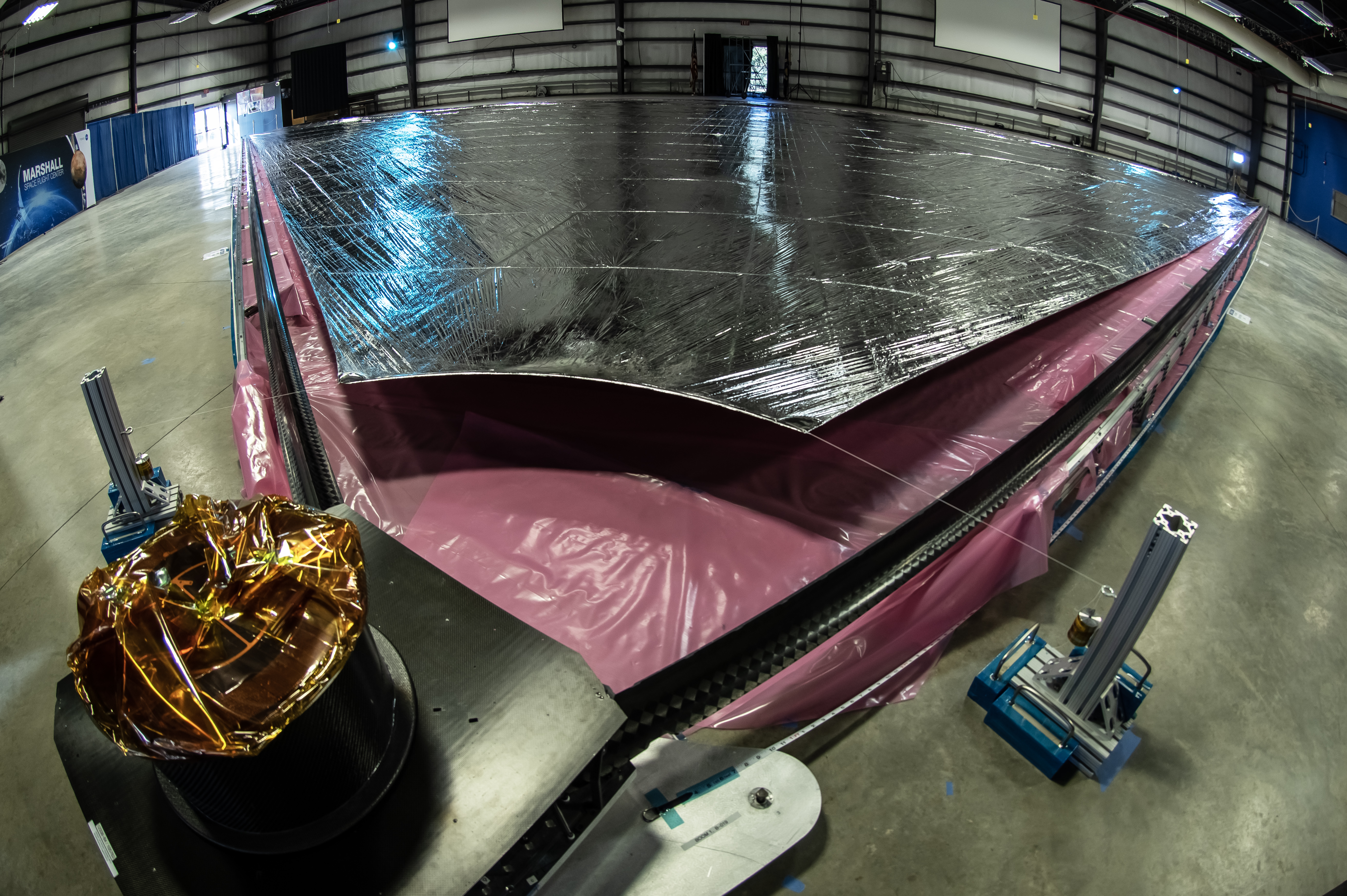
Thrust is produced by sunlight’s gentle pressure (from photons) pushing against thin, lightweight, reflective sheets. When used as primary propulsion, this thrust never runs out. The sail is larger than an Olympic swimming pool and just 2.5 microns thick, thinner than a human hair.
Solar storms and coronal mass ejections can cause considerable damage on Earth by overloading power grids, disrupting radio communications, and affecting aircraft and spacecraft. Solar sails have the unique ability to navigate in close proximity to the sun and solar sails can carry early warning systems to monitor space weather.
This solar sail will be a secondary payload on the NOAA SOLAR-A mission in November 2029. After separating from the launch vehicle, the spacecraft will travel toward a sail-enabled, non-Keplerian sub-L1 halo orbit.
The mission will demonstrate navigation using a solar sail propulsion system, showing how the sail can be controlled and maneuvered in space. It will also verify the performance of a magnetometer aboard a solar sail spacecraft. Magnetometers measure changes in magnetic fields around Earth.
Featured Video
NASA Unfurls Largest Solar Cruiser Sail Quadrant Ever Deployed
NASA and industry partners used two 100-foot lightweight composite booms to stretch out a 4,300-square-foot (400-square-meter) prototype solar sail quadrant for the first time in Building 4316 at NASA’s Marshall Space Flight Center in Huntsville, Alabama, on Oct. 13, 2022. Solar sails use the force of light – not rocket fuel –to fly in deep space. They get a gentle, constant push from sunlight particles, or photons, hitting their giant reflective surfaces. The fully deployed sail covers an area larger than the surface of a tennis court with an aluminum-coated plastic material that’s thinner than a human hair. The full-scale prototype is only a quarter of the sail designed to fly the Solar Cruiser spacecraft toward the Sun and demonstrate orbits that would be difficult or impossible for conventional satellites to maintain.
Partners
Managed by Marshall Space Flight Center in Huntsville, Alabama, this demonstration is funded by NASA’s Space Technology Mission Directorate.
National Oceanic and Atmospheric Administration (NOAA) is partnering with NASA STMD on the S5 project, providing a Launch as a secondary payload with SOLAR-A and a magnetometer.
Through the Small Business Innovation Research (SBIR) program, Applied Aerospace and Opterus have spent years developing technology that will be applied to S5. Applied Aerospace began manufacturing the solar sail membrane flight unit in November 2023 and in January 2026 completed all four quadrants. At 1653 m2, this is the largest solar sail ever built.
Additional Information
FHE Solar Sails Investigation Article

Small Steps, Giant Leaps: Episode 165: Sailing the Solar System
Keep Exploring