A daring mission to lift NASA’s sinking Neil Gehrels Swift Observatory is now one step closer to launch this June. On May 4, Katalyst Space Technologies completed environmental tests of its LINK robotic servicing spacecraft at NASA’s Goddard Space Flight Center in Greenbelt, Maryland. LINK will meet up with Swift and attempt to raise its orbit.
“The Swift boost attempt is a fast, high-risk, high-reward mission,” said John Van Eepoel, Swift’s mission director at NASA Goddard. “Swift will likely re-enter the atmosphere sometime later this year if we don’t attempt to lift it to a higher altitude. Katalyst has gotten to this point in just eight months, and we’re glad they were able to use NASA’s facilities to test LINK and draw on our expertise to help tackle questions that popped up along the way.”
After completing environmental testing, members of the Katalyst team, which is based in Flagstaff, Arizona, shipped LINK back to the company’s facility in Broomfield, Colorado, for additional prelaunch testing.
All spacecraft in low Earth orbit experience drag caused by our planet’s atmosphere. If they don’t have propulsion systems to maintain their orbits, the drag gradually reduces their altitudes. A recent bout of increased solar activity magnified this effect on Swift, which began to sink faster than anticipated.
NASA contracted Katalyst in September 2025 to raise Swift. The company had less than a year to design, build, test, and launch its spacecraft and to rendezvous, grab, and lift Swift.
“We’re in an unusual situation where the schedule dictates how much risk we’re willing to accept, rather than the other way around,” said Kieran Wilson, LINK’s principal investigator at Katalyst. “The clock is ticking on Swift’s descent, so we have to find a balance between testing and problem solving that gives the mission the best chance of success.”
During vibration testing at NASA Goddard, engineers mimicked the shaking the spacecraft will experience during its launch from a Northrop Grumman Pegasus rocket.
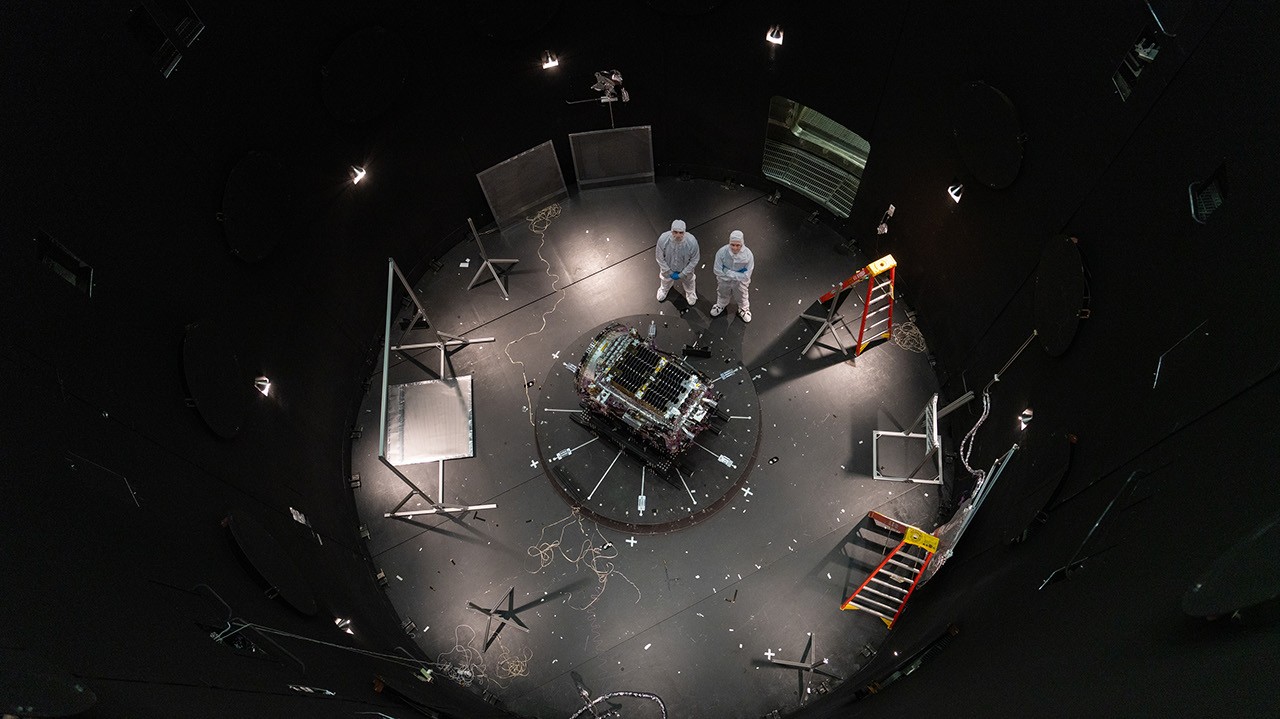
In the footsteps of Swift itself and NASA’s upcoming Nancy Grace Roman Space Telescope, the Katalyst team also used NASA Goddard’s Space Environment Simulator for thermal vacuum testing.
Once the air was pumped out of this 27-foot-wide chamber, LINK experienced space-like hot and cold temperature extremes. The team also practiced firing the satellite’s three xenon-powered ion thrusters and deployed one of the arms.
Northrop Grumman will integrate LINK into the Pegasus rocket in early June at NASA’s Wallops Flight Facility in Virginia. An L-1011 aircraft will deploy the rocket from the Marshall Islands later that month.
Learn more about the Swift mission at:
By Jeanette Kazmierczak
Goddard Space Flight Center, Greenbelt, Md.
Media contacts:
Alise Fisher
Headquarters, Washington
202-358-2546
Claire Andreoli
Goddard Space Flight Center, Greenbelt, Md.
301-286-1940