From Earth orbit to the Moon and Mars, explore the world of human spaceflight with NASA each week on the official podcast of the Johnson Space Center in Houston, Texas. Listen to in-depth conversations with the astronauts, scientists and engineers who make it possible.
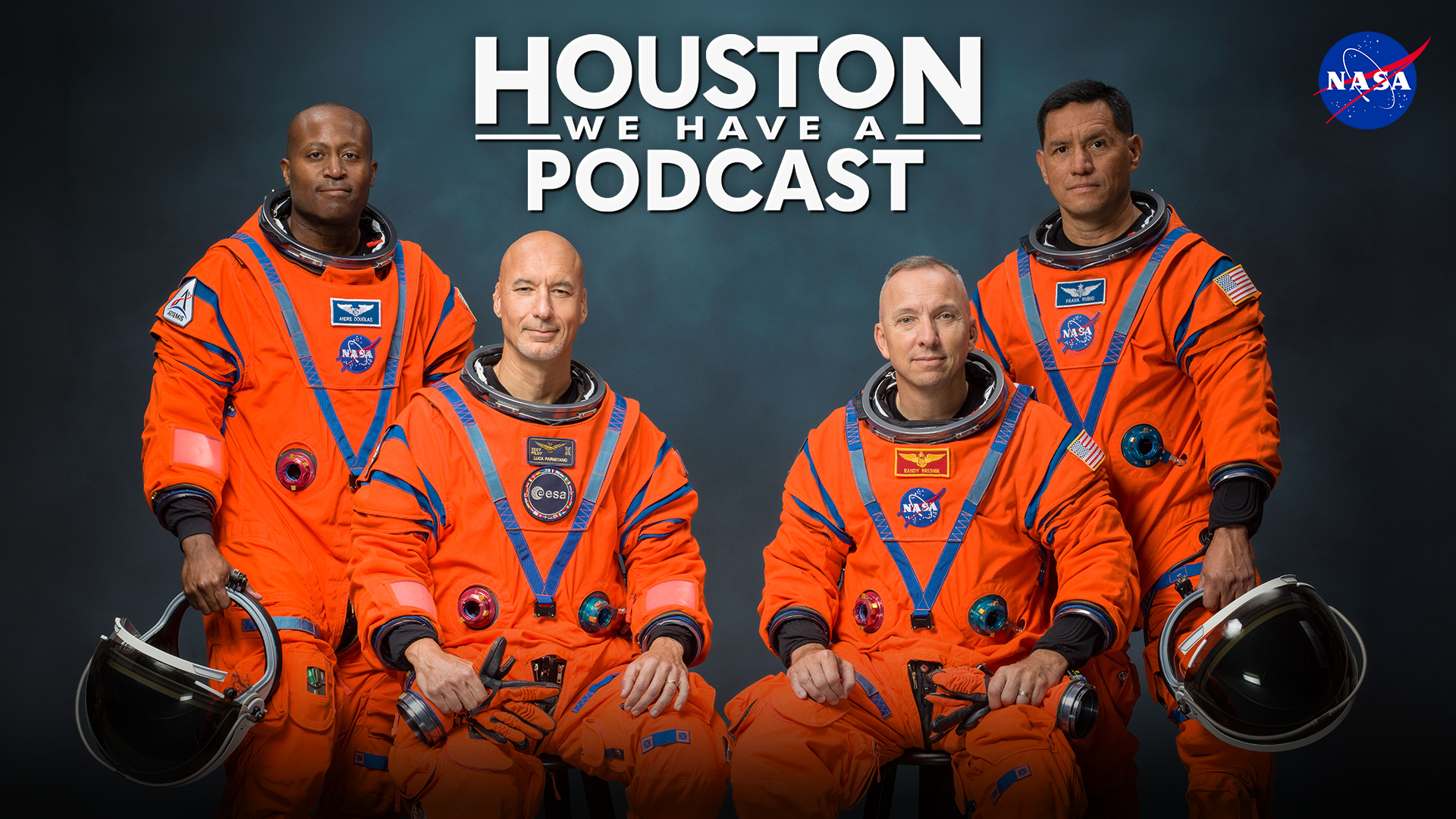
On episode 426, the Artemis III astronauts discuss their backgrounds and training ahead of them to prepare for one of the most complex human spaceflight missions in history. This episode was recorded in June 4, 2026.

Transcript
Nilufar Ramji
Houston We Have a Podcast. Welcome to the official podcast of the NASA Johnson Space Center, episode 426: Meet Artemis III. I’m Nilufar Ramji, and I’ll be your host today. On this podcast, we bring in the experts: scientists, engineers, and astronauts, all to let you know what’s going on in the world of human space flight and more.
On the heels of NASA’s historic Artemis II mission, the agency is preparing to return Americans to the lunar surface and build the capabilities needed to stay there. While NASA continues to advance the systems needed to support a sustained human presence beyond Earth, we here at NASA Johnson are supporting the astronauts and mission teams who are training for the future of space flight.
The Artemis III mission will demonstrate the capabilities of lunar spacecraft in low Earth orbit. A crew of four astronauts will launch in the Orion spacecraft on top of the Space Launch System rocket to test rendezvous and docking capabilities between Orion and commercial human landing systems.
In this episode, we meet the crew of Artemis III, four explorers who will test the spacecraft, demonstrate capabilities, and eventually train crews who will go on to perform these maneuvers at the Moon.
Let’s go, for all humanity.
Nilufar Ramji
First up, we’ll be talking to the Commander of the mission and the Pilot.
The Commander of Artemis III is Randy “Komrade” Bresnik, a Marine Corps test pilot turned NASA astronaut. He’s logged 149 days in space across two missions, flown in both the space shuttle and Russian Soyuz, done five spacewalks totaling over 32 hours, and commanded the International Space Station on Expedition 53. With over 7000 flight hours in nearly 100 aircraft, including combat missions, as an F/A-18 pilot, he blends raw experience with exceptional leadership. A Citadel Military College math grad and University of Tennessee Aviation Systems masters, he’s now shaping Artemis missions at NASA. Before being selected as commander, he was serving as Assistant to the Chief of the Astronaut Office.
Next our Pilot, European Space Agency’s Luca Parmitano, an Italian Air Force test pilot who has spent 367 days in space over two long duration space station missions. He’s flown twice on the Russian Soyuz, conducted six spacewalks totaling 33 hours, and made history as the first Italian and third European to command at the International Space Station during Expedition 61. With over 2000 flight hours across more than 40 aircraft, he blends technical skill with leadership. A political science grad from the University of Naples, he also holds a master’s in experimental flight test engineering.
Let’s meet your Artemis III Commander and Pilot.
Nilufar Ramji
Well, first off, congratulations on your assignments. This is incredibly exciting, but you have lots of work and training ahead. So, tell us a little bit, how you were told you were assigned to the mission, and what was it like when you found out?
Randy Bresnik
I had the fortunate opportunity this flight to have the chief of the astronaut office call a meeting where all the crew members were present, and that was really special for me, because my previous flights, it was me and the chief, and that was it, and my crew wasn’t, you know, who I was gonna be flying with was not there, and so that was just afterwards. I sat and was just really thankful for that, for everybody to find out about each other at the same time.
Luca Parmitano
So for me was slightly different, because I believe that my boss couldn’t quite, the way we say Italian, hold the nut in his mouth.
Nilufar Ramji
He had no poker face.
Luca Parmitano
And so he called me, and I was on a train, so a public space, and at the time I was responsible for the crew on orbit on the on the International Space Station with Expedition on 74 the role, so-called the increment lead, so when I saw the call, I immediately thought that it was going to be something concerning the crew on orbit. And so I answered the phone, and the boss told me, “Hey, Luca, I want you to know that we want you to be the pilot on the Artemis III mission.” And I was very much unprepared for that answer, and so it went through one ear, it didn’t register in my brain, came out the other ear, and I literally said, “Can you say that again?” and it told me the same words, and then it did register, but I was in a public environment, so I knew that I couldn’t say anything out loud, so I was literally speechless, which doesn’t happen very often, and then I was very, very honored when I, when I met the crew for the first time a couple of days later.
Nilufar Ramji
So you all knew each other, but in this configuration as the Artemis III crew you had met, and how are you feeling right now?
Luca Parmitano
Well, Komrade has known me since I’ve been an astronaut, because I came into the core in 2010 So he has known me for my entire professional life as an astronaut. And for me, I can only hope to learn as much as I can from, from the crew, from the team, from my commander.
Randy Bresnik
And certainly you know we started off and have very little time together so far, but the majority of the time we’ve been together we’ve been laughing, and so that is a very good sign to me that you know with the stresses of the limited time or the you know complexity or the weight of the mission that being able to have that levity and comfort with each other will make the mission go very smooth.
Nilufar Ramji
That’s phenomenal. And I want to switch gears here and talk a little bit about before NASA. So you came to the agency, both of you came into space flight, came in as astronauts with several hundred, if not thousands of flight hours under your belt. So do you recall a moment in your early years, maybe when you were growing up, or as you were going through your education, where that interest in flight was sparked?
Randy Bresnik
Well, I certainly was always interested in flight, because our house was under the traffic pattern of the Santa Monica airport, where I grew up, and I looked at the window and just watched planes go around and listen to them. It’s just, it’s just fascinating to me. And so my father was a pilot, but it wasn’t, you know, because of what he did, it was just, it was innately fascinating to me. So I was super fortunate to be able to get a scholarship from the Marine Corps to be attend college, and that then took me to flight school, where you get the opportunity to fly a trainer aircraft, and then they decide what you go to fly, you know, whether it’s jets or helicopters, and so certainly a lot of people have your druthers, but it’s always the needs of the service. So I happened to be at the fortunate time where I did well enough in flight school, where I got selected to fly jets, and then when I finished up my jet training, I was fortunate enough to be able to get selected to be able to fly F-18s. And so you know doing that and being able to master that airplane, become a training officer, attend, you know, Top Gun in our weapons schools was awesome, because you’re the pinnacle of that tactical aviation, and then what next? And so you know, was able to apply for test pilot school, and go to test pilot school, and be able to do that cutting-edge development of stuff that hasn’t been done before, and that to me was just fascinating. Be able to bridge engineering and operations, knowing that I was bringing something to the fleet operators of that aircraft that was going to make things better, more survivable, you know, and be able to employ the weapon system better. And so, you know, doing that, the next, you know, thing that you know is an option is, you know, wow, can I really, you know, do that, have an opportunity to do that thing, and go to space? And in 2000 Doug Hurley got selected as an astronaut, and I’d known him well from our fleet days, and while we were at the Patuxent River Naval Air Station as Marine test pilots, and at that point it was like “if they like Chunky, maybe I’ve got a shot too,” you know. So and then the rest is history. The old school way to become at NASA is a test pilot.
Nilufar Ramji
Right. What about you, Luca?
Luca Parmitano
Incredibly enough, my story is actually also connected to California in one way. I will get there in a second. I was, I was, and to the Marines, so this is serendipitous, but I was always interested in flight and space flight, as a kid. I watched airplanes, and I was curious about how they flew helicopters. Anything that flew really captured my attention, but like many things, it disappeared in my teenager years, where I thought about being a rock star, a professional athlete. There were so many things that I wanted to do. I had hair at the time, so being a rock star was an option nowadays, not so much. But in 1993 I got a scholarship to be an exchange student in the US, and I came to the US to California in Orange County, where my host starter was the schedule commander for a Marine squadron of F-18s.
Randy Bresnik
Which one?
Luca Parmitano
I don’t remember the number of the squadron, but it was El Toro.
Randy Bresnik
1993 I was flying F-18s out of El Toro.
Nilufar Ramji
What?! We’re finding this out right now.
Luca Parmitano
Serendipity is magic. So he reintroduced me to the idea of flying and a military flight, specifically. At the time, you know, as a teenager, I was like every teenager looking at myself and what my future was going to be, and I just felt enamored with the world of military aviation. So, I went back to Italy at the end of the year. I finished high school, and I applied for the Italian Air Force, which is a selection process.
I went in as a pilot, I started flying, and there is a second moment where Lieutenant Colonel Maurizio Cheli, an Italian astronaut, came to talk to us about this space flight on STS-100 and that was the moment when I thought that’s who I want to be. I was looking at the stage at this super humble pilot and astronaut, and I thought there is a path, and, and I just want to know what that is. And I learned that you had to be a fighter pilot, a test pilot, so I put every effort I could into becoming a fighter pilot. And after seven years as a fighter pilot, I went into, into that, I was selected to become a test pilot. I went to a test pilot school, and there, there was a call for astronauts from the European Space Agency. At the time, I was the youngest astronaut, the youngest test pilot in my squadron, and so I thought that that would be fantastic to apply, but probably not, not my chance, because all these other colleagues are more experienced, they’re older, the more experienced they have, more capabilities. So I probably should wait for the next time. And that was my, that was my idea that I was going to have another chance when I had more capabilities and more experience. Except that one morning my schedule commander asked me if, if I had applied for the selection, because he knew that I wanted to be an astronaut, that I was dreaming about that. And I told him, I don’t think that’s, I don’t think that’s my chance, I don’t think it’s the right time, I’m too young, I’m too inexperienced, and he told me, Well, if you don’t apply, you have 100% chance of not being selected.
Nilufar Ramji
Exactly.
Luca Parmitano
Yeah, and at least you have the experience, you’ll see what it’s about. So I felt authorized to do it. And so that night I brought my, my letter of intention. I applied for the selection, and a year later I was being called to Paris to be introduced as a, as a young astronaut.
Nilufar Ramji
What a story. And now you are standing here on the heels of Artemis III. You talk about Randy, you had mentioned, you know, test pilots is the old school way to get in to be an astronaut. So let’s just to contextualize for our audience, you used to manually pilot the space shuttle. Now we have vehicles that are more autonomous. We’re going to Artemis III. It’s going to be manual piloting, because we have to demonstrate the docking capabilities of these human landing systems. So, it’s actually very serendipitous that we have test pilots that are going to be supporting Artemis III. You’ve flown your respective missions to the International Space Station, and those those skills will apply to your upcoming assignment. So, what are you most looking forward to with Artemis III?
Luca Parmitano
Honestly. I’m looking forward to whatever contribution I can give as a test pilot, as an experienced astronaut with a year of space time on the International Space Station, six space walks. That’s one part of it. The other part is that I’m really looking forward to learn and improve my capabilities, improve my experience and just get better at what I do, and hopefully keep giving my contribution to this incredible program.
Randy Bresnik
And so I’ve been in this Assistant to Chief Astronaut job for Exploration for almost eight years now, and so I’ve been working everything Exploration from Artemis I and its first flight to Artemis II and getting the crew on board and now being taking this role for Artemis III, just awesome to see how we are making those incremental steps and testing out our flight envelope and determining the system’s capabilities and testing as much as we can, so that when we have our next mission after this one, it has as much risk bought down and as much stuff proven for its capability that we can, and so I look forward to most is whatever we are able to put into this mission, getting it tested out and, and, and proven, flight proven operations figured out timelines, all that type of stuff, so that we can then go on to Artemis IV, which would hopefully be our moon landing with confidence, because of all the stuff we were able to prove out on our flight.
Nilufar Ramji
Yeah, and so many things that you can learn and train future crew for as well. So, lots of documentation and lots of heavily choreographed and dynamic events.
Randy Bresnik
And certainly you know the amount of training, Artemis II crew had three years to train. They were doing the, they were the first one, so we were figuring out training along the way, they came back and said, hey, we can, you know, make this training more efficient, and so there’s a massive reduction in the amount of hours, because they said we, if we train this way on these particular subjects, we’re gonna be able to train the crew to much less time. Which is exactly what we need, because our mission right now is on the books for in a year from now.
Nilufar Ramji
Yeah, so increasing efficiencies, but also this is exactly what test missions, test flights do for us, right? So, between the spacewalks both of y’all have conducted and the support that you’ve done from the ground, you are seasoned astronauts, and your upcoming assignments, as I mentioned, will involve a series of highly choreographed and dynamic events. So, how do you both prepare mentally and physically?
Randy Bresnik
Well, we are fortunate to have some flight test experience with crew in Orion, so that is massive for that foundation. We’ll be able to get those basics here pretty quick. It’s just in applying how that vehicle, you know, and the experience we gained on Artemis II with the prox operations demo, and that close flying we had with the ICPS, doing that to actual landers, you know, doing that to a Blue lander and a SpaceX Starship during that proximity, doing actual, you know, rendezvous and docking, being able to undock, fly around, that is going to be amazing. For instead of a, a spent second stage, like the ICPS was on the with Artemis II, they see actual lander spacecraft in that view and test these things out here in Earth orbit, so that we can make sure that when we get to lunar orbit, it’s not the first time we’re doing it.
Luca Parmitano
I’m sorry, I was salivating while you were talking. The fascination that I have for test flying comes from being able to go into an environment where we have an idea what’s going to happen, but then you have to be part of making it happen. And specifically for a mission like this one, it really is creating a stepping stone for the future. And it is such an honor to be able to make it better for the next guy, for the next mission to be able to contribute to any to a program so vast, but being at the early stages and doing something for the first time, it’s I would say that is the true nature of test flying, and so as a test pilot, I could not be more excited at the prospect of being part of it.
Nilufar Ramji
Now, let’s go into the preparation. Let’s talk about game day. What do you do on your game day? Do you have any rituals or routines that help your mindset to do something that’s literally out of this world? Is there, is there a song you listen to? Do you hug your kids a certain way? What do you do?
Luca Parmitano
So, since I’ve been a pilot, I have a, not a routine, but there are simple gestures that for me represent the beginning of the mission. If you’re a pilot, the mission is flying an airplane. For me, the moment in which I separated the rest of the world from what was going to happen was locking a canopy. When I locked the canopy on my aircraft, this is 25 years ago now, but it would lock everything else outside, and it was almost an immediate transformation for me. It was the moment that I became one with my aircraft, and now everything outside of this of the aircraft doesn’t exist any longer. It’s me, the mission, the guy on the other airplane, and what we’re going to do. It was that the physical click was almost a switch, and you can replicate that in any environment you are. You go out on a spacewalk, locking the helmet for me was that moment. You know, the click of the helmet, now everything is out, is outside, everything that’s outside of this, on the spacesuit is not important. It’s for later. I could have problems at work, I could have problems with with my family, I could have anything going on, but it stays outside of the head and outside of the spacesuit, outside of the spacecraft, outside of the airplane. And I’m sure that during the 100 of hours that we will spend training together, we will we will find what is that that switch that puts everything leaves everything outside and makes me focus on the on what’s happening in the moment.
Nilufar Ramji
I love that. Top that, Randy.
Randy Bresnik
Well, and it’s called compartmentalization. Okay, and you have to be able to do it so that things that when you’re in a high stress, high stakes, time sensitive environment, that you’re not distracted, and you’re totally focused with all your capabilities, physical and mental, in that one spot. And on launch day, you know, we’ll be getting up, having seen our spouses and kids for the last time, you know, in an intimate environment the day before, and that day you’ll get up, you might have a phone call with them, but then it’s into the routine of the breakfast, the suit up, and all of that. And you’re in your suit doing leak checks, it’s you’re, like it’s game day, but you walk out and you get that one little snippet back to reality, because you walk out and your family’s standing there as you get ready to go in the van and hit the launch pad, you don’t get to touch them, you don’t get to hug them. All you can do is stand across because you’re in quarantine and wave at them, blow them a kiss, you know, give them a give him a heart sign. And then you step on that bus and it’s all business, you know.
Luca mentioned going on a spacewalk in the helmet. I totally resonate with Brother Luca, because on my first flight, on my first spacewalk, my wife was in labor here in Houston with our daughter in the hospital, and once that helmet clicked down, there was going to be no more updates, no more anything. It had to be focused completely on that spacewalk. And on my first spacewalk, I haven’t experienced this. I don’t have any frame of reference. All I have is the training I had here on the ground, but I had to rely on that training and be at peace that me and my spacewalking teammate Mike Foreman were ready to go execute, and they, he needed to build the whole team needed to rely on me to be able to compartmentalize and turn that switch off until I got back inside. I thought, you know, during when I got back inside, we’re repressurizing the airlock, that when that helmet came off and the switch could be turned back on, they’d be saying, “Hey, Komrade, you’re a father, and unfortunately for my wife, she was still in labor. That’s a different story.
Nilufar Ramji
Poor thing!
Randy Bresnik
She did say “top that.
Nilufar Ramji
I’m sorry, I know. I’m just like, I want to talk about mental preparation, and-
Luca Parmitano
I’m so happy that you said that!
Randy Bresnik
That was really good. I was- there’s only one story that could have topped that, that was my wife’s in labor on the ground…
Nilufar Ramji
Okay, Artemis I tested the Space Launch System, and Orion Artemis II certified the vehicles as human rated. These test flights help support the foundational building blocks for humans to get closer to the moon. Now you have the task of testing another part of the mission, the commercially developed human landing systems. How does it feel to take us closer to being on the Moon again?
Randy Bresnik
The most important Artemis mission is the next one. Everything has to proceed, you know, with these steps. You can’t just go straight to the lunar surface without having done Artemis II, without having done Artemis III. And so, as Luca has said, what a privilege to be a part of that. And Orion, we’ve got one flight with crew on board, you know, are we able to do a longer mission and prove that out? Are we able to do things that we didn’t have time to do on our own? Start, we’ll expand the flight envelope or testing the heat shield, the new heat shield for the first time. And so there’s all these things that are still expanding the envelope of Orion, so that we can feel comfortable that that part risk has been brought down, and when we go to lunar surface, the new part is actually taking that human landing system and actually touching down on the surface.
Luca Parmitano
For anybody who hasn’t seen the HBO series, From the Earth to the Moon. Is one on one of the episodes, it’s about Apollo 9, one of my favorite episodes, because in that, in that event, what was happening is that there was a crew that was going to perform testing of the lunar lander, and they were going to be, they were not going to land on the moon, and then they told them there is, we’re going to anticipate another mission, and we’re going to send Apollo 8 around the moon and back, but because you, you were assigned first, we want to, we want to give it to you the opportunity to step into Apollo 8 instead of performing Apollo 9, and the crew gets together, and they ask them what you want to do, and they look at each other and they’re like, well, they might be going to the moon and back, but our mission is fun. Because they’re all test pilots and they were testing systems, and that’s what we will be doing. But that the Orion spacecraft that we’re going to fly is very different from the one that’s already flown, there’s there’s testing systems that that we’re going to have to do, and then we’ll be testing lunar landers and maneuvers, and at that mission is is so much fun.
And so I, the way I feel about it, I feel that it’s an incredible contribution, I feel that it’s important, and if you, if you think about grappling up a mountain, there is always somebody that needs to plant that nail, so that somebody can go and use that nail to be safe and go on, but exploration is a mountain without a summit, so our only hope is that we can just plant the nail well enough, so then the next person can go above and beyond, and then they can plant another nail, and the next crew can go up and and go higher and higher. So when Komrade said the next mission is the most important, I think I like to think that it’s always the next mission, not the one that’s coming after Artemis III, but the one that’s coming and coming and coming is always going to be the most important, and so the idea of contributing that way for me is the essence of what we do.
Nilufar Ramji
I love that. So, what I’ve heard from you two today is: one, you love the thrill, you have a great game day plan, and I couldn’t think of a better commander and pilot to be assigned for Artemis III, so congratulations again. We’ve gotten to, we’ve gotten to know you a little bit, so that’s been good, but I want our listeners to get to know you a little bit more. So are you ready for a rapid fire?
Randy Bresnik
Yes.
Nilufar Ramji
Okay, let’s go. Morning person or night owl?
Randy Bresnik
Morning.
Luca Parmitano
Morning person.
Nilufar Ramji
Me too. Not that I’m playing. You walk into your coffee shop. What’s your go-to order?
Luca Parmitano
Caffe macchiato.
Randy Bresnik
I don’t drink coffee.
Nilufar Ramji
No caffeine at all. Tea, anything?
Randy Bresnik
No tea, no coffee.
Nilufar Ramji
Oh, okay. That’s good. Sweet or salty?
Luca Parmitano
Salty.
Randy Bresnik
Salty at night, sweet in the morning.
Nilufar Ramji
Ah, nice. Phone call or text?
Luca Parmitano
Nowadays, text.
Randy Bresnik
Phone call
Nilufar Ramji
What kind of pet? If you, any of you, have one.
Luca Parmitano
I love dogs. I was adopted by a cat.
Nilufar Ramji
Oh, you did mention before we began recording. that’s your boss.
Luca Parmitano
My boss, yes. Tati.
Randy Bresnik
I have become a dog person.
Nilufar Ramji
Become a dog. Okay. Book or movie?
Luca Parmitano
Book.
Randy Bresnik
Movie.
Nilufar Ramji
Thank you for joining us.
Luca Parmitano
Thank you for having us.
Nilufar Ramji
Next up, our two Mission Specialists.
Francisco “Frank” Rubio is a U.S. Army Colonel, physician, and NASA astronaut. Rubio holds the American record for the longest single spaceflight: 371 days aboard the Space Station, having flown on Soyuz MS‑22 and 23 during Expeditions 67–69. A veteran UH‑60 Black Hawk pilot with over 1,100 flight hours and over 600 combat hours in Bosnia, Afghanistan, and Iraq, Rubio later earned his MD and served as a flight surgeon before joining NASA’s 2017 astronaut class. On his mission he performed three spacewalks totaling 21 hours 24 minutes, and contributed to critical long-duration space medicine and station maintenance experiments.
Last but certainly not least, our fourth crewmember, Andre Douglas. He’s a U.S. Coast Guard Reserve Commander and versatile systems engineer from the Johns Hopkins University Applied Physics lab. His Coast Guard time included search and rescue operations, ship salvage response, and drug interdiction missions. While with Hopkins, he worked space exploration design and test missions, nuclear ballistic missile defense, and multidomain autonomous systems development. This is his first flight assignment, but he’s no stranger to Artemis. Douglas was key to Artemis II serving as a backup crew member, fully trained and ready to step in if it was needed. He was also the astronaut support person on the closeout crew handling astronaut ingress and strap in before the Space Launch System and Orion launched earlier this year.
Let’s meet your Artemis III Mission Specialists.
Frank, Andre, welcome to the fun, and congratulations to both of you. You’re about to go into an intense training flow, but before we get there, tell us a little bit about how you were told you were assigned to the mission, and what was it like when you found out? How did you feel?
Andre Douglas
Well, I think it was amazing, but we were all called into Maker’s office, that’s our chief, and he said, “Hey, come on in.” There was a few of us in person, and then there was a few online, and basically said, “Hey, you guys are assigned as a crew,” and it was nice to have people there and talk about it, and kind of give some hugs and some handshakes, and it was.. it was really nice, I would say, just very nice.
Nilufar Ramji
Were you shocked, or did you anticipate that it was coming? Maybe Andre?
Andre Douglas
I kind of anticipated that it might come, so I wasn’t too shocked, but I was still kind of like, oh, this is nice to have with the crew to get it all at once. So that was really, really nice.
Frank Rubio
Yeah, it was awesome to find out with the crew that day. I had had a conversation with Scott a couple of weeks prior as some final pieces were being decided for several missions, and so to come together with these guys and see the crew eye to eye was pretty exciting, and knowing what we were going to participate in for the next year, year and a half is just a, it’s, it’s exciting, but really it’s humbling, right? Just to know that you’re lucky enough to be selected, it’s a huge honor. So, yeah, happy to be here.
Andre Douglas
Yeah.
Nilufar Ramji
And like your crew mates, you are both members of the military, so thank you so much for your service. Frank, as a pilot, was this always the dream for you? And Andre, you’re with, you were with the Coast Guard. What is it that drew you to serve with them? So, let’s start with you, Frank.
Frank Rubio
Yeah, honestly, my dream was always to be a physician, working with a special operation. So, I was actually living my dream when I decided to apply for this job. And the reason was, you know, the more I looked into the mission, the team, it was something that I thought would fit me perfectly, and just so appealing to, you know, think that I could possibly be a person that could help explore space, right? I never once in a million years thought I’d be selected, but when you find something that you think might fit so perfectly, you got to give it a try, and so, yeah, so you know, ultimately, even though it wasn’t my dream, it has actually worked out to fit exactly the way I imagined.
Nilufar Ramji
I love that.
Andre Douglas
Yeah, and I think for me, for the Coast Guard, my parents served in the Coast Guard, so my dad was in the Coast Guard, and then my mom, she was in the Marine Corps, the Army, and the Air Force at different points. Yeah, at one point she was Air Force Cadet, and then she did the reserves for the army and taught nursing, and then she was in the Marine Corps, she got her scholarship with Penn State and went enlisted and everything, so she did all of that, and I remember as a kid she used to take me to all of her nursing courses across the country. And then you know growing up with my dad and having him go off to duty and just serve and not be there, like this concept of service was just kind of permeating throughout my, my life. And so for me, you know, when it comes to serving the Coast Guard, I thought, man, being in service, but for humanity, right, humanitarian service, the Coast Guard was what I chose. I thought about Air Force, thought about. All the other services, and they’re great too, but the Coast Guard was like, “Hey, let’s go save some lives. So that’s been kind of my calling to serve with them, and currently in the reserve, and did active duty before, but it blends well into NASA, right? It’s we’re serving humanity, we’re serving the public, and it makes it that much easier to do as we’re doing that job day to day, and it’s an honor to be here, just like Frank said, but the service makes a big part of it, you know, come easier, and just honored to be here. So-
Nilufar Ramji
Both of you are so humble. And Frank, you are a space station veteran, and Andre, you trained alongside the Artemis II crew. So, how have these experiences informed what you’re about to get into, and tell me a little bit more of what you’re looking forward to?
Andre Douglas
Yeah, so I think you know being with Artemis II was very, very special, because you know, before I got assigned, I was actually getting very involved with the architecture, understanding the rovers, the suits, understanding the, you know, potential habitat, either orbiting or on the surface of the Moon, and understanding that this is a massive organization with a lot of different players. You know, as I was going through the astronaut candidate training program, I just focused on my T-38 you know, my flying, my diving, the little tactical things that would make me a good operator, but like having context of this is a big machine, and it’s going to take a lot of people to do hard things, and to see Artemis II go off and it to go well was awesome. But knowing behind the scenes all of that stuff that comes together, it’s impressive. So having that perspective coming into this crew and this mission, it helps to just have that context, so I can know where to focus, and you know, contribute the best that I can. Seeing how things at the end of the previous flow went, where I could have made changes and additions early, like I can do that now, and I can help the crew and everybody see certain things, and so I’m just happy to bring that to the table, and it’s just a nice vantage point to have in the past.
Frank Rubio
Yeah, and I think Dre captured it perfectly. The number one thing is that we are part of an awesome team, right, and one of the coolest parts about our team is that we do help to inspire humanity. Both from outreach to engineering to exploring, right, and getting on the rocket and going to space, and ultimately space is awesome, right? And so we’re going to work our butts off for the next year and a half, and it’s going to be challenging, and then you get to get on a rocket and go to space, and it’s absolutely worth every little bit of work that you’re going to put into it. So a lot of work, a lot of sacrifice, but ultimately the payoff is both incredibly fun and amazing, and then a few minutes after that, it hits you that how privileged you are to be able to do it, and that we are helping to inspire future generations, and it’s pretty cool that you know, really, regardless of what mission you’re doing, it’s all of those things, but being part of a mission now that’s going to help set the foundation for a program that’s going to take our nation and humanity back to the Moon and then onto Mars, that feels, I think, a little bit extra special, just being part of that foundation for something, right, and something that’s bigger than ourselves. So, so, yeah, super excited about it.
Nilufar Ramji
And the four of you as this this team making something happen that involves a series of dynamic events, but lots of lots of coordination and choreography you’re going to have to do as you prepare for Artemis III. How do you, how do you do this? How do you prepare both mentally and physically for a mission like this?
Andre Douglas
Yeah, I think that’s a really good question, and sometimes I think that’s different than what you’ve done in the past. I know for me it helps to do a lot of mental prep with respect to procedures, and you know, all the tasks that you’re going to do on the mission. So, some of the things that we do, which is translatable from what we did early in the astronaut candidate training program is something called Chair Fly, right? So I’m sitting in a chair right now, and I’m envisioning where am I going to be. I’m going to be either on Station, I’m going to be in Orion, and I’m going to think about, okay, I have to get my suit off. I have to work my cuffs on my gloves, and then I have to work my helmet. I have to figure out how to get my head out of the neck ring, and I’m going to talk through those motions. I’m going to actually physically move in that manner without the stuff, but I’m going to mentally and physically connect those actions in my mind, right? I’m going to chair fly. I’m going to do all on the chair. That goes with space walks out the door, that goes with other procedures on the display units. These are our DUs that we, we do in commanding Orion. I’m going to go to all these different menus in my mind, so that when I’m there in the moment, I’ve already done that mental prep, and it becomes more automatic as I’m executing, and it helps a lot. I think from an operational standpoint, that’s very helpful.
So that’s the mental prep, and the physical prep to me is about it’s not just. Working out, so you can get stronger and faster. It’s actually working out, so you understand your response, your physiological response. How can you control your breathing when you get super tired? How can you know, you know, how to control your heat load and things like that? Because it can get hot in Orion, it could get cold in Orion, all these different environments we might encounter based on our mission, which we’re still learning about, right? So, if you can control your body in terrestrial like conditions and understand and test bed a little bit, I think it’s a great way to know, like, no matter what happens, I know kind of where my limits and I can make decisions based on those. So, I think it’s important to definitely train the brain and the body as much as possible. But those are some methods that I would employ.
Nilufar Ramji
What about you, Frank?
Frank Rubio
Yeah, I think ultimately it comes down to trust and confidence, right? Trust in the team that’s going to train us, and knowing that they have put in way more work than we ever will into developing all the possible scenarios that we could encounter, and training us over and over for those things, and that repetition builds confidence, right? And so when you do strap into that rocket, you think of all those people who’ve trained you, and it just gives you confidence that, like, we- you know, hopefully the mission will go perfectly, but when it does not, because it just never does go perfectly, we are ready and trained to deal with almost any contingency you can imagine.
Nilufar Ramji
So this segues perfectly into my next question. Now, what happens if things don’t go as planned? So, Frank, you had a bit of an extended work trip to the space station, to put it lightly, and Andre, you were training alongside Artemis II, as I mentioned, just in case. So, now, how have these experiences informed how you approached an unplanned or anomalous situation? Now, Frank, let’s start with you.
Frank Rubio
Yeah, so I think again, there’s a confidence in knowing that you are ready for everything you’ve trained for, right? You just put in a lot of time and effort, as Dre said, but then also part of our job is just to be ready to improvise and make things happen, right? And you do that in communication with the ground team, right? There’s an incredible team led by a flight director and all the flight control teams, and they’re ready to support and provide you as much information and data as you need, but ultimately, sometimes you just need to improvise and make something happen. I think that’s one thing that all of our backgrounds contribute to, is you just learn and are comfortable making the best out of a situation that you may not have ever thought of, or you know, couldn’t have imagined. But then you assess, you take store of what’s available, and then you make the most of it, and usually it turns out pretty well.
Andre Douglas
Yeah, I think those are really good words, Frank. I mean, it’s, it’s crazy, too. When we train, a lot of the public does not see all of the plan B’s and C’s and D’s and E’s, and so, in addition to the confidence in the reps that we get, we get reps in all of those scenarios, and it’s, it’s pretty awesome to have that, that breadth of experience. And one of the things I think that also helps, that we can do, as well as, you know, all of our trainers train us, like Frank said, they can also give us these guiding principles that can try to fit all the impossible scenarios that gives you that 80% solution, because we can’t get every scenario when we’re doing our sims right, but you know, if you know that a box on a system has data power cooling right, and you may not know the specifics, but you know that you have basic functions, and we have to reset it in Orion. We need to troubleshoot through those basic functions. Those are ways to kind of help bound the scenario, and I think that’s a decent method to help with preparing for the unknown.
But at the end of the day, like, the more that we practice and more that we trust the team, then the better off we’re going to be, but there are some little techniques that may help from like a first principle standpoint, and so especially like as we’re doing these things, we can easily talk in this room about how to solve the problems when we’re comfortable, we got oxygen, we’re hydrated, but when things start to degrade and it helps to fall back to the first principles, so we’re not overthinking and just completely off kilter there. But yeah, those are some things I think about when trying to make sure we prepare for that off nominal.
Nilufar Ramji
You two are exceptional humans, and given me lots of tips for myself here on the ground with the oxygen and the hydration. So, speaking of hydration, I wanted to switch gears and talk a little bit about meals, they bring us together, and food just is something that everyone loves. So, let’s talk about some of your favorite meals that you had, Frank, while you were in space, or that you, Andre, tried in the food lab. Is like, what are you guys going to eat?
Frank Rubio
You know what I learned is you’re going to eat whatever they give you.
Nilufar Ramji
That sounds like what I tell my kids now! That’s dinner.
Frank Rubio
You know, actually, it was a lesson that was reinforced, and something I already knew from the army, right? Like, unfortunately, the environment that you usually placed in doesn’t allow for gourmet meals, and ultimately, you just have to have the energy you need to conduct a mission. But what, what being in space for that long reinforced is it’s not really the meal, it’s the people you’re sharing it with, right, and just ultimately you can be sharing some pretty untasty food, and it’s still an awesome experience, right, and you’re sharing stuff with each other, and you’re fellowshipping, and smiling and laughing, and ultimately that’s what the part that matters, and I’m pretty confident we’re going to do exactly that. So, not to minimize, you know, our Food Lab’s awesome, so they do provide us with some great food, but ultimately, again, it’s not going to be, you know, foodie gourmet food, right? But we’ll make the most of it, it’ll be awesome, and it’ll be good memories from, I think, those times around the table.
Nilufar Ramji
That’s true. The camaraderie.
Andre Douglas
Really good words, Frank. I mean, somebody told me in our office that food is better shared. It just tastes better shared. There’s a psychological thing, you know, that that goes to it. So, I think that’s all there is to it. It’s gonna taste good when we’re together, you know, going through whatever we’re going through, the ups and the downs, and so I completely agree. As far as Food Lab goes, I think the one thing I tasted that I thought was pretty decent was the brisket. I think there was some brisket there, and I was like, “Oh, I’m in Texas, maybe I’m a true Texan now.” I don’t know, I wouldn’t have said that maybe like eight years ago, but I was like, “Oh, I’ll do the brisket.” But other than that, yeah, I think it’s all gonna taste pretty good.
Frank Rubio
Now I’m just gonna imagine Randy as our Commander, being like, “Here’s your food!”
Nilufar Ramji
This is dinner.
Andre Douglas
Good Luck!
Nilufar Ramji
The first meal you had when you came back from space, your gourmet meal, what was that, Frank?
Frank Rubio
You know, we have some awesome support personnel. One of those teams is the people who pick us up from when you land on a Soyuz from Baikonur, and so you have about a 24 hour travel back to Houston, and they had reached out and said, “Hey, what do you want your first meal to be?” And I was a little aggressive, thinking, “Oh, I feel great, and I want steak and salad.” And you know, the first leg of that flight from Kazakhstan to Scotland, I did not feel great. So I had to wait for the second leg from Scotland back to Houston, and actually felt great. I enjoyed a steak in the salad, and it was fantastic.
Andre Douglas
That’s a good idea. Yeah, that’s..
Frank Rubio
I wouldn’t recommend it right away, but eventually.
Andre Douglas
Yeah, see, we learned from our peers.. This is good.
Nilufar Ramji
Okay, now I did this with Luca and Randy, but I want everyone to get to know you, so I’m going to do some rapid fire questions. Are you ready?
Frank Rubio
Ready.
Nilufar Ramji
Okay, let’s go. Morning person or night owl?
Andre Douglas
Morning person.
Frank Rubio
Also a morning person.
Nilufar Ramji
All four of you are morning people. This is gonna be great. Good team!
You’re going for a run. Are you listening to music, podcast, or alone with your thoughts?
Andre Douglas
Definitely music for me, and running.
Frank Rubio
Alone with my thoughts.
Nilufar Ramji
You know what the right answer would have been? You’re listening to Houston We Have a Podcast!
Frank Rubio
Of course.
Nilufar Ramji
Phone call or text?
Andre Douglas
Phone call.
Frank Rubio
Yeah, 1,000% phone call. I think texts are easy to misunderstand.
Nilufar Ramji
Agree. You don’t get tone.
Frank Rubio
And yeah, and as someone who is occasionally sarcastic… doesn’t come across.
Nilufar Ramji
I respect that. What kind of pet, if any, do you have?
Andre Douglas
I don’t really have any true pets. The kids have a fish or two.
Nilufar Ramji
A fish or two. Okay.
Frank Rubio
Yeah, you might have asked the wrong person on this one. So, I, we have a small little farm, and-
Nilufar Ramji
I love that! Tell us about that!
Frank Rubio
So I have two dogs, three cats, five ducks, and 17 chickens. Yeah, so we got rid of the goats and turkeys, but yeah, we had a little bit more before that.
Nilufar Ramji
So egg prices didn’t affect you,
Frank Rubio
But that’s for another podcast. No, egg prices definitely do not affect us.
Nilufar Ramji
Do you have a comfort movie or show?
Andre Douglas
So, man, my just favorite movie is Interstellar, and that sounds cliche, but I just really enjoyed it. Show-wise. I actually recently finished a series, it’s an anime series called Dr. Stone. I don’t know if you’ve ever heard of it, but it’s about this – it’s about the earth, and apparently everybody on earth turns to stone, and they don’t know why. But then there was this one character who, like, drank an energy drink right before it happened, and he counted for like 30,000 years or something, and then he broke out of the stone, and then he took his time breaking everybody else out of the stone using like bat feces fluid or something. And like it talks about, the thing that’s crazy is, it talks about all of the, all of the human-made inventions over time, and it’s like, how do you make an iPhone? How do you make a wheel, like all these things? It’s insane. So I thought that was, like, at first kind of crazy, and I started watching them, like, oh. It got me. It’s I finished it. And yeah, that was an interesting one. I did not expect, so I’ll leave it at that.
Nilufar Ramji
Top that, Frank!
Frank Rubio
Bat feces fluid is a difficult one to…
Nilufar Ramji
I can’t stop laughing- I’m crying!
Andre Douglas
I do what I can.
Frank Rubio
I was like, huh, how can I weave that into my story? And you just can’t.
Nilufar Ramji
It’s its own thing.
Frank Rubio
Yeah. So I don’t watch a ton of TV, but when I do, I love college football. And so for four months out of the year, I’ll enjoy that on a Saturday. And then I actually don’t love the show myself, per se, because of who usually wins, but my kids love Survivor, and so that’s become a regular staple, just because they enjoy watching it. So, watching it with them. So, yeah,
Nilufar Ramji
Learn by watching or learn by doing.
Andre Douglas
Oh, by doing. I’m a learn by doer.
Frank Rubio
That’s interesting, because I always associate the two things together, together, yeah. Usually, if I can watch it and then do it, that’s pretty ingrained.
Nilufar Ramji
I need someone to sit there and teach me as I’m doing it. I will perform a lot better, it’ll retain in my, my head more.
Frank Rubio
Yeah, yeah. But, like, you know, I can watch a YouTube video and pretty much feel like MacGyver, right? Like, anything in the world now, I can do. Yeah, I don’t know what people did before. I guess I probably hired a bunch of other people.
Nilufar Ramji
Well, we are limited on time. So, thank you guys so much for being here. We appreciate you being on the podcast. And once again, congratulations on Artemis III.
Frank Rubio
Thank you.
Andre Douglas
Thank you.
Nilufar Ramji
Thanks for sticking around. I hope you’re as excited for Artemis III as I am!
You can check out the latest from around the agency at NASA.gov. And you can find out more about Artemis III at NASA by visiting nasa.gov/artemis.
Our full collection of episodes, and all the other wonderful NASA podcasts, can be found at nasa.gov/podcasts.
On social media we are on the NASA Johnson Space Center pages of Facebook, X, and Instagram. If you have any questions for us or suggestions for future episodes, email us at nasa-houstonpodcast@mail.nasa.gov.
This interview was recorded on June 4, 2026.
Our producer is Dane Turner. Audio Engineers are Will Flato and Daniel Tohill. And our social media is managed by Leah Cheshier and Kelcie Howren. Houston We Have a Podcast was created and is supervised by Gary Jordan. Special thanks to Anna Schneider for helping us plan and set up this interview. And of course, thanks again to our Artemis III crew, Randy Bresnik, Luca Parmitano, Frank Rubio, and Andre Douglas, for taking the time to come on the show.
Give us a rating and feedback on whatever platform you’re listening to us on, and tell us what you think of our podcast.
We’ll see you next week.
3… 2… 1… This is an official NASA podcast.