August 12, 2026
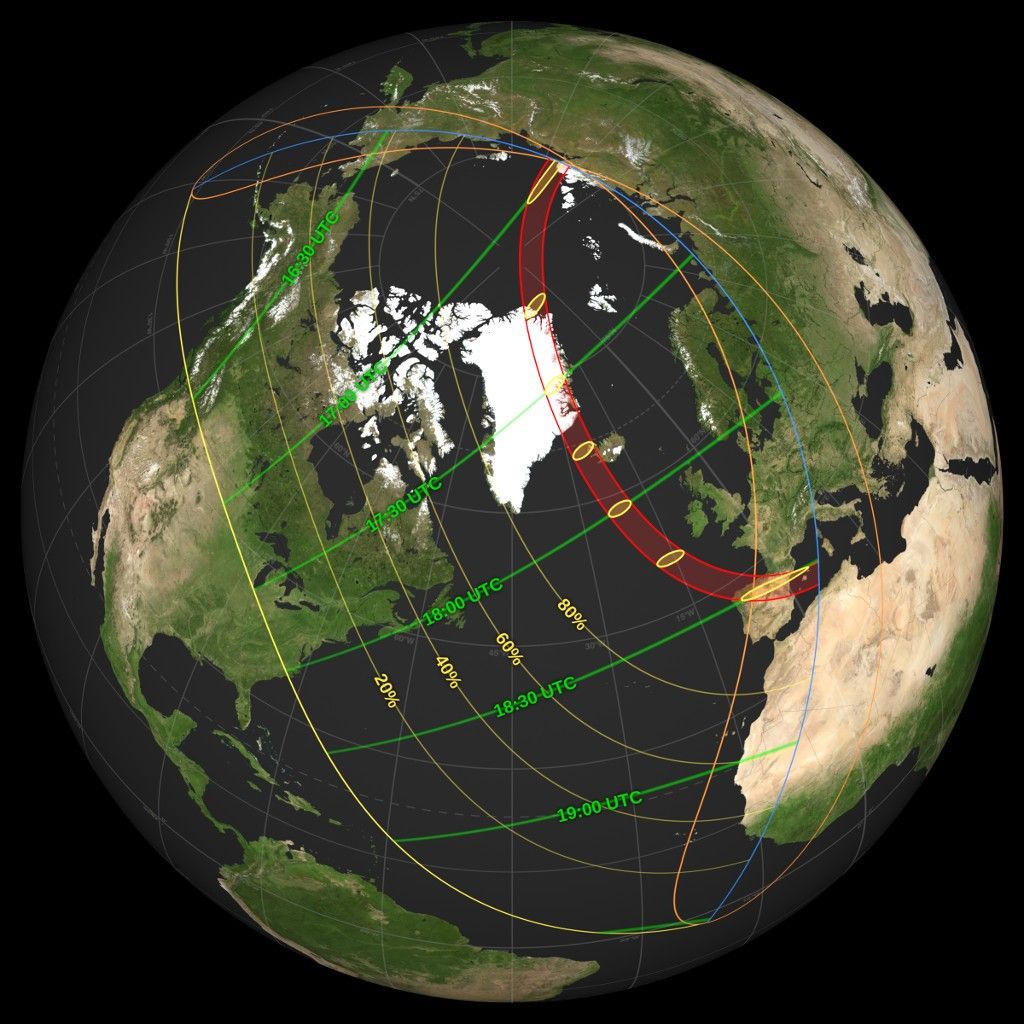
On Aug. 12, 2026, a total solar eclipse will sweep across Greenland, Iceland, northern Russia, the Atlantic Ocean, Spain, and a small corner of Portugal.
Many other places in the Northern Hemisphere will experience a partial solar eclipse that day, including parts of the northern U.S. (from Alaska to North Carolina), most of Canada, much of Europe, and northwestern Africa.
For many along the western part of the eclipse path (in mainland Europe and Africa), the Sun will set while it’s still partially eclipsed, creating an opportunity to see a sunset eclipse.
Eclipse map
Total solar eclipse
When the Moon slips in front of the Sun, those in the center of the Moon’s shadow will experience a total solar eclipse.
For a small, remote region in northern Russia, totality — when the Moon completely covers the Sun — will occur mid-day. For Greenland and Iceland, the Sun will go dark in the late afternoon or early evening. In Spain and the very northwestern tip of Portugal, the Sun won’t be fully eclipsed until the late evening, shortly before sunset.
For most in the path of totality, the Sun will be fully eclipsed for less than two minutes. For anyone near the very center of the eclipse path in Greenland, Russia, or the North Atlantic, totality will last a little longer (but still less than two and a half minutes).
Only during those brief moments of totality, when the Moon completely blocks the Sun’s bright face, can viewers look directly at the eclipse without eye protection.
Before and after totality, everyone observing the Sun must use eye protection to view the partial phases of the eclipse, when the Moon is covering only part of the Sun’s disk. Observers can use solar viewing glasses (often called “eclipse glasses”), handheld solar viewers, or other safe solar filters that block out most of the Sun’s light and prevent eye damage. Eclipse watchers can also use an indirect viewing method to enjoy the partial phases of the eclipse, such as making as a pinhole projector to cast images of the Sun.
Learn more about how to view a total solar eclipse safely.
Partial solar eclipse
For eclipse watchers inside the Moon’s shadow but outside the path of totality, the Moon will never completely block the Sun and the eclipse will be partial only. During a partial solar eclipse, it is never safe to look directly at the Sun without proper eye protection.
The Aug. 12 partial solar eclipse will begin as the day begins in northern Russia. In Alaska and northern Canada, the eclipse will start and end in the morning, while Canada’s eastern provinces will experience the eclipse in the afternoon. In the northern contiguous U.S., the partial eclipse will begin around midday, lingering into the midafternoon for those farther east. The eclipse will reach the U.K., Ireland, mainland Europe, and Africa in the evening.
Those in the U.S. and southern Canada will see only a small “bite” taken out of the solar disk as the Moon appears to just clip the Sun. Those closer to the path of totality — across most of Europe and in northwestern Africa — will see most of the Sun get covered up.
When watching a partial solar eclipse directly with your eyes, always look through safe solar viewing glasses (“eclipse glasses”) or a safe handheld solar viewer. Eclipse glasses are NOT regular sunglasses; regular sunglasses, no matter how dark, are not safe for viewing the Sun. Safe solar viewers are thousands of times darker and ought to comply with the ISO 12312-2 international standard.
Do NOT look at the Sun through a camera lens, telescope, binoculars, or any other optical device while wearing eclipse glasses or using a handheld solar viewer — the concentrated solar rays will burn through the filter and cause serious eye injury. A special-purpose solar filter must be attached to the front of any telescope, binoculars, camera lens, or other optics to observe the Sun safely.
If you don’t have eclipse glasses or a handheld solar viewer, you can use an indirect viewing method, which does not involve looking directly at the Sun. One way is to use a pinhole projector, which has a small opening (for example, a hole punched in an index card) and projects an image of the Sun onto a nearby surface. With the Sun at your back, you can then safely view the projected image. Do NOT look at the Sun through the pinhole! Leaves on trees act as natural pinholes, projecting the shape of the eclipse onto the surface beneath them.
Learn more about how to view a partial solar eclipse safely.
Where to watch
Below are some details about the eclipse for select cities. All times are local.
An asterisk (*) under “Partial Ends” indicates that the eclipse will end after sunset and the time given is for sunset.
Total eclipse
| City | Partial Begins | Totality Begins | Totality Ends | Partial Ends |
|---|---|---|---|---|
| León (Spain) | 7:32 p.m. | 8:28 p.m. | 8:30 p.m. | 9:22 p.m. |
| Reykjavík (Iceland) | 4:47 p.m. | 5:48 p.m. | 5:49 p.m. | 6:47 p.m. |
| Valencia (Spain) | 7:38 p.m. | 8:32 p.m. | 8:33 p.m. | 9:01 p.m. * |
| Zaragoza (Spain) | 7:34 p.m. | 8:29 p.m. | 8:30 p.m. | 9:07 p.m. * |
Partial eclipse
| City | Partial Begins | Maximum | Coverage | Partial Ends |
|---|---|---|---|---|
| Anchorage, Alaska (USA) | 7:36 a.m. | 8:21 a.m. | 28% | 9:09 a.m. |
| Bangor, Maine (USA) | 12:54 p.m. | 1:53 p.m. | 24% | 2:49 p.m. |
| Boston, Mass. (USA) | 1:01 p.m. | 1:55 p.m. | 16% | 2:46 p.m. |
| Detroit, Michigan (USA) | 1:03 p.m. | 1:36 p.m. | 3% | 2:08 p.m. |
| Fairbanks, Alaska (USA) | 7:37 a.m. | 8:27 a.m. | 37% | 9:18 a.m. |
| Juneau, Alaska (USA) | 7:41 a.m. | 8:24 a.m. | 17% | 9:08 a.m. |
| New York, New York (USA) | 1:07 p.m. | 1:54 p.m. | 9% | 2:38 p.m. |
| Philadelphia, Penn. (USA) | 1:11 p.m. | 1:53 p.m. | 7% | 2:35 p.m. |
| Portland, Maine (USA) | 12:57 p.m. | 1:53 p.m. | 19% | 2:27 p.m. |
| Washington, D.C. (USA) | 1:17 p.m. | 1:53 p.m. | 4% | 2:27 p.m. |
| Algiers (Algeria) | 6:42 p.m. | 7:33 p.m. | 96% | 7:42 p.m. * |
| Barcelona (Spain) | 7:35 p.m. | 8:29 p.m. | 99% | 8:54 p.m. * |
| Berlin (Germany) | 7:15 p.m. | 8:08 p.m. | 85% | 8:38 p.m. * |
| Casablanca (Morocco) | 6:48 p.m. | 7:43 p.m. | 87% | 8:20 p.m. * |
| Dakar (Senegal) | 6:25 p.m. | 7:12 p.m. | 37% | 7:34 p.m. * |
| Dublin (Ireland) | 6:12 p.m. | 7:10 p.m. | 94% | 8:05 p.m. |
| Edmonton (Canada) | 10:02 a.m. | 10:38 a.m. | 6% | 11:15 a.m. |
| Halifax (Canada) | 1:58 p.m. | 3:00 p.m. | 31% | 3:58 p.m. |
| Kraków (Poland) | 7:18 p.m. | 7:56 p.m. | 64% | 8:04 p.m. * |
| Lisbon (Portugal) | 6:39 p.m. | 7:36 p.m. | 95% | 8:29 p.m. |
| London (U.K.) | 6:17 p.m. | 7:13 p.m. | 91% | 8:06 p.m. |
| Madrid (Spain) | 7:36 p.m. | 8:32 p.m. | 99% | 9:16 p.m. * |
| Milan (Italy) | 7:27 p.m. | 8:20 p.m. | 92% | 8:35 p.m. * |
| Montreal (Canada) | 12:50 p.m. | 1:45 p.m. | 18% | 2:38 p.m. |
| Nuuk (Greenland) | 3:30 p.m. | 4:35 p.m. | 79% | 5:39 p.m. |
| Oslo (Norway) | 7:02 p.m. | 7:57 p.m. | 83% | 8:49 p.m. |
| Paris (France) | 7:22 p.m. | 8:17 p.m. | 92% | 9:09 p.m. |
| St. John’s (Canada) | 2:28 p.m. | 3:35 p.m. | 53% | 4:37 p.m. |
| Saint Petersburg (Russia) | 7:59 p.m. | 8:51 p.m. | 79% | 9:00 p.m. * |
| Stockholm (Sweden) | 7:03 p.m. | 7:56 p.m. | 81% | 8:46 p.m. * |
| Toronto (Canada) | 12:55 p.m. | 1:40 p.m. | 8% | 2:23 p.m. |
| Tunis (Tunisia) | 6:41 p.m. | 7:11 p.m. | 50% | 7:14 p.m. * |
| Vienna (Austria) | 7:22 p.m. | 8:10 p.m. | 85% | 8:13 p.m. * |
| Winnipeg (Canada) | 11:25 a.m. | 12:02 p.m. | 5% | 12:40 p.m. |