From Earth orbit to the Moon and Mars, explore the world of human spaceflight with NASA each week on the official podcast of the Johnson Space Center in Houston, Texas. Listen to in-depth conversations with the astronauts, scientists and engineers who make it possible.
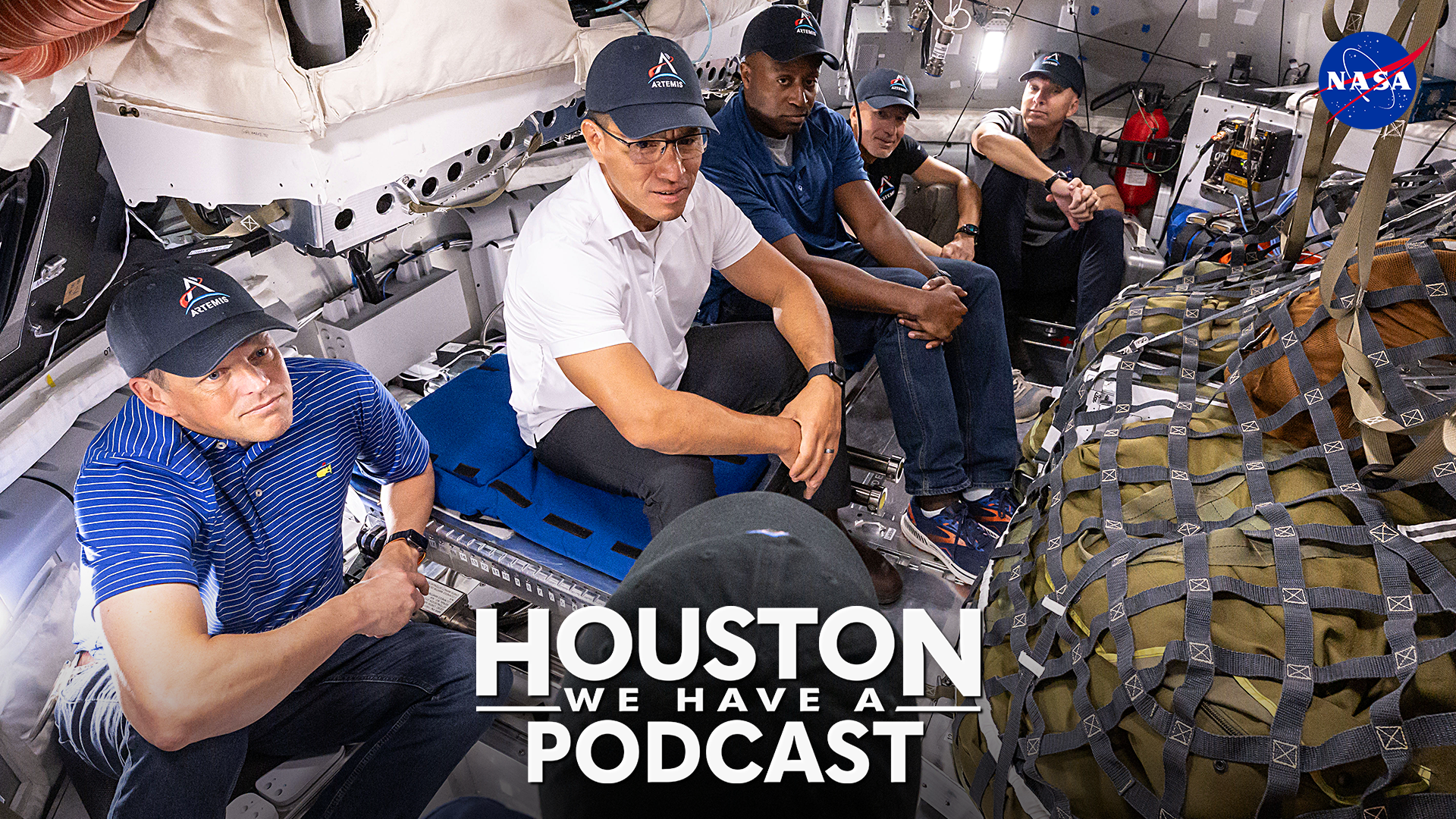
On episode 434, NASA Artemis III Chief Training Officer Debbie O’Connell discusses how the crew is preparing for each phase of their mission, from launch to lunar operations and splashdown. This episode was recorded August 7, 2026.

Transcript
Leah Cheshier
Houston We Have a Podcast. Welcome to the official podcast of the NASA Johnson Space Center, episode 434: Artemis III Training. I’m Leah Cheshier, and I’ll be your host today. On this podcast, we bring in the experts, scientists, engineers, and astronauts, all to let you know what’s going on in the world of human spaceflight and more.
On June 9, 2026, we officially announced the crew of Artemis III, NASA astronauts Randy Bresnick, Frank Rubio, and Andre Douglas, and European Space Agency astronaut Luca Parmitano, with NASA’s Bob Hines as their backup. The very next morning, these crew members reported for the start of their training. That training is managed by none other than their CTO or Chief Training Officer, Debbie O’Connell.
As Chief Training Officer, it’s Debbie’s job to help plan, develop, and implement the crew’s training and simulations that prepare them for the entire mission, from launch to docking with commercial lunar landers, deorbit, and splashdown back on Earth. We spoke with her about what it takes to ensure the crew is ready for each milestone and moment, both expected and unexpected, that they’ll encounter on one of NASA’s most challenging missions yet.
Let’s dive in.
Leah Cheshier
Hi, Debbie. Thank you so much for joining us today on Houston We Have a Podcast.
Debra O’Connell
Yeah, I’m excited to be here.
Leah Cheshier
Well, I want to talk about Artemis III. Obviously, you are the chief training officer. But before we get into what you’re doing right now, tell me about the beginning. Tell me about you. Did you always know you wanted to work at NASA? How did that come to be?
Debra O’Connell
Yes. So no, actually, I didn’t. I didn’t know. I didn’t know what I wanted to be at all growing up. I was one of those kids that anything sounded awesome. I couldn’t decide on what I wanted to be. So I did go into engineering. I nailed that down in high school. Like I’ll be an engineer. NASA wasn’t even on my radar until a recruiter came, and didn’t believe it was a real job. Of course, I applied. I was ecstatic, telling my mom she didn’t believe me, you’re going to go train astronauts. No way. But it’s it’s it’s a dream job. Absolutely.
Leah Cheshier
Were you in college when you met a recruiter?
Debra O’Connell
Yes.
Leah Cheshier
Okay.
Debra O’Connell
Yeah.
Leah Cheshier
Where did you go to school?
Debra O’Connell
Embry Riddle down in Florida.
Leah Cheshier
And you got your aerospace engineer degree.
Debra O’Connell
Yep, love of airplanes. That’s how I got there. Even that didn’t start as a kid. My dad would drag me to air shows instead of vacations. It was always hot, not something I enjoyed until I got older, and then just the powerfulness of an of an airplane and the engine, and going farther, faster, exploring. Of course, that intrigued me. So it’s not a surprise that I love my job here because it definitely relates.
Leah Cheshier
That is so cool. I agree. Every I didn’t grow up with a lot of exposure to aircraft, but now being so close to Ellington Field and my husband works there, I am constantly in awe of the T-38s, the WB-57, the engines, how they have outfitted the WB-57 or the G5 for whatever mission that they’re coming up with next. So totally love the fascination with airplanes. So if you were recruited when you were in college, this has been your only job here at NASA?
Debra O’Connell
Yeah, my only like full time job, of course. Yes. Been here for about 15 years.
Leah Cheshier
Okay, nice. Yeah, same here. Came right out of college, never left. It’s been 11 years. So, tell me more about what you did prior to becoming the Artemis III CTO.
Debra O’Connell
I was an Ethos, Environmental and Thermal Operating System, flight controller when I started, so I trained the emergency system, the thermal system, the ECLS, Environmental Control and Life Support, system, and I spent about 10 years of my time doing that before I came over to CTO. And I did. I got to do some really cool projects, so I got to be part of DM-1, DM-2, the first the first Dragon missions, and drafting up all the procedures for those, and then when I jumped over to CTO, they let me do Starliner work. So I got to work on some really cool vehicles before I jumped over to Orion.
Leah Cheshier
And so your time as Ethos was obviously for the International Space Station, right?
Debra O’Connell
Yes, for the International Space Station.
Leah Cheshier
You are getting really smart in a lot of different spacecraft.
Debra O’Connell
Yeah. Yes, this assignment was the first time that I got to jump over to Orion, so I was excited to join in. But it was a big leap to jump in, not knowing anything about Orion.
Leah Cheshier
Yeah, it’s a whole new world, whole new spacecraft, whole new mission, trajectory, and plans, and very, very interesting. And so, talking about being a CTO, you mentioned that you got to do some of that work starting on Starliner. Have you done any of it for Dragon?
Debra O’Connell
Yes, I was Ethos for Dragon on DM-1, DM-2, Crew-1, so I did a lot of Dragons in the early days on the ISS side. So training emergency procedures, working with SpaceX on creating some of the joint concepts.
Leah Cheshier
Okay, well I want to break down the role of a CTO. What does that role consists of what does it encapsulate?
Debra O’Connell
Yeah, a CTO is responsible for managing the training. So a lot of that is just putting the pieces together, but it also involves making sure we have the hardware and the facilities to train the software and the the capabilities to do some of the training. We also lead a team of incredible instructors, and I’m there to validate that the crew’s ready to go. They’re trained up.
Leah Cheshier
Awesome. Well, as a CTO, what personal skills or experiences that you’ve had- do you have anything that has turned out to be unexpectedly useful in this role?
Debra O’Connell
That’s a tough one. Um, I would say to hit on the unexpected part, it would be motherhood.
Leah Cheshier
Really? Oh my gosh! Tell me all about this. I am, I am seated and ready.
Debra O’Connell
It was actually the first thing that I told the Artemis III crew is the two things you have to know about me is I’m hard-headed and I’m a mom. The hard-headed part that was that was a joke. Right after they were assigned, we had our first training event before I even got to sit down with them, and I stood up too fast, bumped my head. It made a- everybody noticed. They all looked at me. Are you okay? So just trying to play that off is yeah. I’m hard-headed. I’m good to go. But motherhood, it is, definitely helps me deal with the chaos better to let go. The mama bear voice comes in handy when you’re running big events as well.
Leah Cheshier
Yeah, absolutely. I’m I’m a mom too, and so I’m so fascinated in all that that entails. You know, you are a manager of your own schedule, obviously, but of somebody else’s schedule and time, and keeping up with everything they do and need. And that does feel a little bit like what you do as a CTO, I guess, right?
Debra O’Connell
Yep. Oh, yeah. There’s a lot of parallels. You’re also constantly training little kids on new things, so you get to see how they learn best. It’s different training an adult, but the techniques are still there.
Leah Cheshier
Yeah, and it’s true. Everyone learns differently, just like we say every kid is different. You know, every adult is different too. And thank goodness for it. It’d be kind of a boring world and place to work if we were all the same. But yeah, thinking about how you’d have to adapt and manage different people and and the way they learn and what they need to succeed- that is such a good connection to motherhood. I love that.
Debra O’Connell
Yes, I maybe take work home too much too. My kids get to hear about- We do safety drills in my house, we do fire drills. We do evacuation drills. I there’s no turning it off on either side.
Leah Cheshier
No, that’s a good thing. I mean, everybody should be doing. We haven’t done a fire drill yet, but he he’s just learned to walk. So okay, maybe carrying him. But no, I mean everybody should do that. So those are good parts of your job to take home and make sure everybody knows where to go stand and who to call and what to grab. That’s cool.
Debra O’Connell
Exactly.
Leah Cheshier
So tell me a little bit more about how you were asked to take on this role. I mean, like you said, this is a huge jump from space station to Orion. Whole new vehicle. Whole new planetary body. How were you asked to take this on, and and what did you initially think about that?
Debra O’Connell
I was very ecstatic. This is a dream assignment. Super excited. I don’t think that’s how it came up across. I’m just a super stoic person, and I think my initial reaction was, “Yeah, I I will think about it.” But of course, I was jumping for joy inside. It is a big excitement. I did go home and make sure my husband was okay with it. We had a six-month-old at the time, two other kids. Like this is a career choice that is going to involve some extra time. But went back to work the next day and was like, I’m all in.
Leah Cheshier
That’s so cool, and it is. I mean, being a CTO, I would think, and taking on any mission of this caliber, it does require extra time. You know, it does mean you probably work a little bit longer or later than you normally would, because we are expecting this mission to come up really quickly. Next year, 2027. That is really fast. So I know that the crew started training the day after they were assigned.
Debra O’Connell
Eight A.M. the next day.
Leah Cheshier
Crazy! I saw them at 4p.m. the day of the announcement. We had some folks here that were getting to interview them, and and you know we were all sending them home and saying, “Have fun at training tomorrow morning. And so you were you were there. You were ready for eight a.m. training that next day.
Debra O’Connell
Of course, bumped my head and everything. No, it has been fast and furious.
Leah Cheshier
Moving into Artemis III specifically, what does a normal day look like for you as a CTO?
Debra O’Connell
A normal day… I think what is consistent from day to day, as I’m rarely at my desk. I spend most of my time in front of a cockpit trainer with the crew members, or over in Building 9 in a mockup, or in Building 5 in a sim with the crew members. So I spend most of my time with the crew. But if I’m not there, I’m in a meeting or creating a PowerPoint, so that’s really the the day to day of what being a CTO is.
Leah Cheshier
So, do you attend every single simulation or training?
Debra O’Connell
I do not. No, and I don’t need to. I couldn’t even if I tried. We have multiple training events going on at any given point, so there could be two or three training events that we have the crew split up. But I don’t need to. We have the instructors there teaching the lessons. Most of the time I am not the actual one teaching it, but I am there to make sure that the training is consistent. It’s moving forward. It’s fitting together nicely, and that we’re going to meet our target, which is next year. So it’s a really quick turnaround. So making sure that we’re on track.
Leah Cheshier
The CTO for Artemis II was Jacki Mahaffey. We talked to her back on episode 353, and she was the first person to train a crew for flying in Orion. So, have you gotten to spend much time with her to learn about how she did things? Has she told you what to expect? You know, what are the lessons learned there?
Debra O’Connell
Yeah, she was the first person, and so far the only other person to have that role, so I have absolutely spent some time with her. Luckily, she did not go far after the assignment. She got promoted to actually be my my management, so we we do get to see each other on a weekly basis. And she’s been incredible in making sure that we’re moving in the right direction and helping us out.
Leah Cheshier
Yeah, I was going to say it must be nice to have her close. I feel like she could get in Orion and probably fly to the Moon herself.
Debra O’Connell
That with the sims, she jumps in and is able to fill the role,
Leah Cheshier
And that’ll be you by the time that you’re done with Artemis III. That’s crazy.
Debra O’Connell
I hope so. Yes, I want to be a Jacki when I grow up.
Leah Cheshier
I think a lot of people would agree. It’s very cool, and she’s great at what she does. So, what are some of the lessons learned that we picked up from Artemis II and that training period that are being carried over to Artemis III?
Debra O’Connell
Yeah, Jacki started with pretty much nothing. Like she had to create the training products, the training flow, the facilities, making sure we had the hardware and the software to do the training. So she did a huge building block that I am building off of to find the most efficient way to get through the training flow. We’re trying to do it much faster now. As for new technology, we’re of course improving things. But I think my favorite my favorite addition that we have since Artemis II is we have now the ability to play back the cruise sim performance. Yeah. So after they support a sim, we can play it back with them and point out certain areas of where they could do better, or where their teamwork could improve, or the verbiage that they used, or maybe even what they saw in the display. We can play that back and show it to them as a learning opportunity.
Leah Cheshier
I think another thing too has to be the fact that we’ve now flown humans on Orion.
Debra O’Connell
Yeah, we’ve learned a lot.
Leah Cheshier
Yeah, and a lot about everything from the ECLS system, Environmental Control, and Life Support system, to just living for people inside that space for an amount of time. And I think having them available to discuss lessons learned directly with the crew has to be helpful. But I’m thinking too about something I know that we do for missions on SpaceX’s Dragon is we have the audio from the spacecraft that you can play for the crew, so they know what to expect whenever you know the reaction control system is maneuvering or we’re pivoting to starfield maneuvers or something like that. So, do we have anything new like that from Artemis II, or were we initially using the sounds from Artemis I for that?
Debra O’Connell
We were, we were, and then we got feedback from this last mission of what was accurate and what wasn’t. That’s great. So we are already incorporating those into our our simulations, updating the sound files. We try to make it as realistic as possible. It really helps with the fidelity of the the training and making sure it’s effective.
Leah Cheshier
Yeah, that’s very cool. I mean, I think even about the training that happens in the Neutral Buoyancy Laboratory, where astronauts are practicing for a spacewalk, and they also practice for moonwalks now. But you know, you hear them after they conduct a spacewalk outside the space station say that it is so similar to what we have in the NBL. They felt so prepared, and I think that hopefully, with the cadence of these Artemis missions continuing, it just gets to that point of wow. You know, trans lunar ejection burn sounded the exact same, or everything on the displays was exactly as I expected, and the image in the window looked just like it did that day, and so I think it’s just very cool now that we’re starting to get real human data. How we can incorporate that and make it even more like reality.
Debra O’Connell
Absolutely, always improving.
Leah Cheshier
So, can you give me a rundown of some of the different courses the crew is required to take as part of their training.
Debra O’Connell
Yeah, so we have divided it up into different sections, and what they’re in right now is fundamentals, which sounds like a 101-type lesson, but it’s like that on steroids. So it’s it’s the crash course of Orion. We’re trying to hit all the high points. So it it is like two weeks of very intense training.
After that, they’ll move into you know what it’s like to do a burn. They have procedures and steps that they have to perform every time we translate Orion. And then we just jump right into you know malfunctions, ascent malfunctions, entry malfunctions. We we try to train for all the worst case scenarios. After that, you know, we we’re we get the opportunity to to practice getting in and out of the the vehicle, making sure that that’s nice and smooth. But most of the crew’s time, we spend on doing simulations. We spend a lot of time over in Building 5 running through simulations in our mockup over there.
Leah Cheshier
So, for all the simulations that the crew does, are those always simultaneous with the flight control team, or do they sometimes do simulations that is it’s just for the crew?
Debra O’Connell
We do both. It’s really we have the option to do what we need to do. Most of our simulations will be with the flight control team because working as one big team is what we’re shooting for. But we do have some crew-only sims where we can do malfunctions that maybe just aren’t that exciting for the flight control team, like losing communication with the capsule. The flight control team just loses all their data, has, no one to talk to. So it it’s not as exciting. Whereas that’s when the crew role really picks up.
Leah Cheshier
Yeah. Oh, yeah, that makes perfect sense. Another portion of training that I find really interesting is just life inside Orion, and I mean they have to learn everything from how to store their content to even picking out food. So they’re going to do their food tasting and training, and do they get to select what they’re gonna fly for each individual crew member? How does all that work?
Debra O’Connell
Yes, yeah, they get to do food tastings. In my mind, it sounds a lot like when you’re getting married and you get to you know try some cake, but it’s it’s a little bit more of a a decision. They’re you know they’re predicting what food they’re gonna eat a year from now. That’s a big decision from from me.
Leah Cheshier
Yeah, me too.
Debra O’Connell
I would I would struggle with that. But they do get some day in the life training. We go through stowage. We go through trash. We go through how you store things and where we store things. The the the. Day to day life operations is really what they’ll spend most of their time doing, and being prepared for that, so that they could be efficient and not be frustrated by it. You know, that’s what we’re shooting for.
Leah Cheshier
Yeah. What do you think is the most challenging part of training for the crew? I mean, I know that they’ve only been hit like feet to the pavement, pounding the pavement for a couple of months now, but what do you think is most challenging?
Debra O’Connell
You know, I think the most challenging part is what they’re in right now. It’s the very beginning. It’s it’s a fire hose of information. It’s it’s a square wave. They have to take in a lot of information and start processing just so many different aspects of the vehicle. So it’s hard. It’s hard to get started, but then once they get their feet under them, it just moves a little bit smoother.
Leah Cheshier
That makes perfect sense. So tell me a little bit about Artemis III as a crew. You’re probably the person that’s getting to know them best as a unit at this point. So tell me a little bit more about how they work together.
Debra O’Connell
They’re an all-star team. I’d say the the thing that stands out to me is that they’re all very dedicated to this mission. They’re all in to be a test pilot, to to make the next step forward so that we can go to the Moon.
Leah Cheshier
That’s very cool. I mean, this is a different mission than anything we’ve done in a long time since Apollo. Getting the opportunity to dock with you know commercial landers. So I think that would probably be as Victor Glover was saying, talking about the proximity operations demonstration on Artemis II. This also has to be a test pilot’s dream, getting ready to to dock with commercial landers. Very cool.
Debra O’Connell
It has to be, yes.
Leah Cheshier
Can you tell me a little bit about each crew member, what they bring to the table, how it’s been to work with them?
Debra O’Connell
Yeah, I think their background is incredible. They are overqualified for this this role. Like they all came in with excellent backgrounds, and really, what makes them so perfect for this assignment.
Debra O’Connell
So Komrade, Randy Bresnik, he was the the exploration lead in the astronaut office before this assignment. So he had his hands on everything for Artemis II. So he has he has incredible background in the history that’s been happening with Orion over the last 10 years. He’s probably one of the most knowledgeable people on Orion, with with the history that’s, just the evolution that has occurred.
And then you have Dre, of course, Andre, who as the backup crew member for Artemis II, Andre already knows most of everything we’re going to teach him. He is bringing in that experience and the the techniques that the Artemis II crew did. He’s able to bring that to the table and share that with this crew.
Then we have, let’s see, Luca. Luca and Randy both have, to me, it seems like very similar backgrounds. That’s probably why they work together so well. But they both come from a test pilot world. Both come from a military background, and then of course, Luca is well known for his experiences on the ISS and handling stressful situations. And you could see that in training already that he is calm, cool, and collected.
And then you got Frank, who who has this medical background that is exceptional, and then comes with all of that knowledge that none of the other crew members are coming to the table with. So that that is pretty unique when you you come from a medical background, and invaluable when you’re in space.
Leah Cheshier
Yeah, for them to be- I mean, they do have a lot of similarities, but they each do bring something so interesting and dynamic and different because when I think about Frank too, you know, he ended up staying on the space station a little longer than he expected as well, and so he’s really good at adapting to you know changes and situations. And like you mentioned Luca and staying cool under stress and and I remember filming something with Randy, or Komrade, back in it must have been like 2017 or 2018 about Orion. So he, I mean, he probably eats, sleeps, and breathes this. And I feel like they’re all a little bit spoiled to have the experience that Andre has had going through all this training before. And so, like you said, he knows what to expect. I feel like, I mean, he’s not a cheat sheet, obviously, but it’s it’s got to be so nice to have someone who has seen this from start to finish and can be a go-to for them. So I’m very excited to see this crew eventually fly. I mean, it’s it’s a great group.
Debra O’Connell
Yeah. Yes. Absolutely. You said it better than I did there.
Leah Cheshier
No, I don’t think so. I’m I’m just excited. So how does training a crew for Artemis differ than training a crew for the space station? Besides, you know, the fact that it’s Orion and maybe the Moon, things like that.
Debra O’Connell
Yeah, I think the the biggest difference to me is that for Orion, we’re still developing the ops concepts, the hardware, the the vehicle is still being developed while we’re doing the training. So for ISS, the mission is pretty set when you start training. You you know roughly what you need to do, and some of the experiments that’ll be on board, and you can you can really train towards that for Orion, the mission the mission is set, but the timeline is still up in the air, and the ops concepts they’re still being developed while we’re training. So you really have to focus on general skills and vehicle knowledge so that it can all come together in the 11th hour when everything’s been decided, and you know exactly what the mission’s going to be.
Leah Cheshier
That’s a great point. I mean, versus we’ve had people flying on the Space Station coming up for 26 continuous years now, and so that is quite a drastic difference versus one space flight of humans on Orion for 10 days. So, very, very, very good point on we’re building it as it’s being flown.
What is something that the public might be surprised to learn about from astronaut training for Artemis missions?
Debra O’Connell
I think the most surprising thing is how little of our training I want them to use in flight.
Leah Cheshier
That’s a good point.
Debra O’Connell
Like we spend most of our time training worst case scenarios, different failure things that could go wrong, and ideally nothing-
Leah Cheshier
Yeah.
Debra O’Connell
Nothing off nominal happens during the mission. But by practicing all of those failures, they’re learning the process. They’re working as a team. There’s a lot of skills that are applicable, but the exact scenarios we train, I hope they never use it.
Leah Cheshier
Yeah, no, that’s a great point because I mean there’s there’s so much work that goes into preventing a really bad day and preparing for a really bad day, and everybody’s hope is that hey, I’m working on this thing that you never touch or that you never have to call to mind, which is such a funny a funny thing, but it gives people peace of mind and it gives you confidence in the mission, and it gives the crew confidence in the spacecraft and the ground teams, knowing that every single little item has been worked through. That’s a very, very funny and great point. Hoping that they never have to call back what it’s like to execute a fire response or something like that.
Debra O’Connell
Yep, exactly.
Leah Cheshier
Tell me about training so far. Is there a moment that has stood out to you, just in in some way? If it’s good, if it’s challenging, anything unexpected yet?
Debra O’Connell
What stood out the most was actually last week. We got the crew all suited up, and we put them in the capsule like it was the day of launch, and we walked and talked through some things. But just watching them on the video feed, all four of them in there, all suited up, it felt real.
Leah Cheshier
Yeah.
Debra O’Connell
It it felt like watching Artemis II Crew on launch day. So that’s when I first got the goosebumps, and I’m like, this is really happening. This is real. Like this is what it’s going to feel like on launch day. So I mean, I that was just an exciting moment.
Leah Cheshier
It’s so cool. I see it in my mind, kind of like those scenes in a movie where you’re watching something real time, but then you flash forward to what’s coming up, and then it’s launch day all of a sudden, you flash back to that moment. I don’t know
Debra O’Connell
Exactly. I went into mom mode. I took a bunch of pictures.
Leah Cheshier
Good. I’m sure they’ll appreciate that, and you’ll thank yourself too when they launch next year. So, talking about training, you know, you were you were saying earlier how it’s part of your job to make sure everyone is totally finalized in what they need to know. How do you know when- what officially marks the end of training? How do you know that they are ready to go fly the spacecraft?
Debra O’Connell
That’s a great question. You really know once you get in a sim and you just see the entire team, not just the crew, but the entire team working together well. And we won’t have everything perfected and nailed down, just perfect. But when we get to a point where we are solving problems together and we’re doing it in a timely fashion, you you see that transition and you know you’re ready.
Leah Cheshier
That’s very exciting, and it just so happens that usually coincides with launch day. So. How do you kind of make that schedule? Like you pick or you know the target launch time, and you work backwards from that on how how to make sure everyone’s trained up on their system.
Debra O’Connell
Yeah, we absolutely train all the way up to launch day. We don’t waste any, any of the time. Yes, you you have the ability to morph training with the time frame that you have. We have focused on trying to find the most efficient way to train, which is why we’re throwing the crew in so much faster and at a base level of knowledge that you know typically we would give them more background before we throw them in a simulation where they’ll see things that they’ve never seen before. This time we’re not. We’re throwing them in early. They’ve never seen these procedures before. They may have never even heard of some of this hardware, but we’re giving them instructor that can like teach in the moment, and we’re learning together. It’s it’s a fast and furious way to learn. It’s a little- It’s probably a little bit frustrating. I don’t know. I’m not in their their seat, but I can imagine it would be a little bit frustrating to try to get up to speed really fast. But they are doing excellent. We’re like four simulations in, and they they have already improved so much. They are able to execute the timeline, stay up with the timeline, solve problems. So it is so exciting to see.
Leah Cheshier
Yeah, I can’t say I’m surprised. These are four really sharp guys.
Debra O’Connell
Exactly.
Leah Cheshier
Yeah, that’s very cool. So tell me, let’s imagine it’s next year, and imagine it’s launch day. Where will you be, and what will you? What do you think you’ll be feeling on that day?
Debra O’Connell
I hope I am at KSC watching them launch live in person. Probably crying. I will be excited. I’ll be nervous. You know, I’ll definitely be in mama mode of like I care about these people, and we just spent the last year training our butts off. But so excited to see them launch.
Leah Cheshier
Yeah, absolutely. I would love to to be at a launch, especially for Artemis. I can’t even imagine, and especially knowing how close you’ll be to them at that point. Really, seeing your friends going to space-very cool. But during the mission, what will you be doing? You’ll be we be here at JSC.
Debra O’Connell
I will be here. Yes, plugged in, glued in as much as I can to this mission while it’s happening. Like this is this is what we’ve worked for, and we’re expecting to learn so much during this mission, that I will be glued to the TV or to the FCR, you know, watching every minute of it.
Leah Cheshier
Let’s assume that the mission is going super smoothly. What do you think the most critical phase of Artemis III is from a training perspective?
Debra O’Connell
Rendezvous, absolutely. That is that is the new untested thing that we are doing. So meeting up with HLS, our landers, and docking for the first time-that is what we plan on focusing most of our training on.
Leah Cheshier
So we talked about preparing for a bad day, but what are the unknown unknowns that you also have to plan for? Like, how do you even plan for that? How do you even determine what that is?
Debra O’Connell
I feel like this is a trick question. How do I plan for the unknown unknowns? Like I said, everything is being developed while we’re training. We don’t have the luxury of it just being done and ready, and we know exactly what to train. So that is a big part of it: is just being prepared for things to evolve and to change last minute. So whenever we can focus on a generic skill or just a generic technique, we we absolutely do that. And then I am expecting things to come up that I didn’t plan for, so I factor that into the time that we have to train.
Leah Cheshier
Well, if you need anyone to try and use a crystal ball and think of the unknown unknowns of a million things that could go wrong, just feel free to ask me because I am-I can be that person. I’m always dreaming up these random situations that could only happen in a movie.
Debra O’Connell
So I think we need to hire you as an instructor. That’s exactly what we do. You’re only limited by your imagination usually. So…
Leah Cheshier
Chief Imagination Officer.
Debra O’Connell
Exactly.
Leah Cheshier
All right. I’m proud. When the crew comes home, what? The first thing you think you’ll want to ask them?
Debra O’Connell
I’m just gonna hug them, and they’re gonna get a hug, and then after that, we’ll probably go right to business. I’m you know like lessons learned. What did we miss? What should we improve on?
Leah Cheshier
Yeah, it’s important to ask while it’s still fresh, but they’re gonna say nothing. They’re gonna be so they’re gonna be so well versed in everything that you’ve taught them. They’re going to be like “Debbie, this was the best training ever.”
Debra O’Connell
Yes, that is exactly what they’re going to say.
Leah Cheshier
Okay, guys. Hope you’re listening.
So, how is what you’re building now going to help the future crews who land on the lunar surface?
Debra O’Connell
Yeah, this is a test flight, so we’re hoping to unlock the next step, the next step to get us there, and we’re going to test out everything that we can that now buys down the risk for the next mission. And that comes to to that for training. We try to train as much as we can that will allow them to do that in flight.
Leah Cheshier
It’s so funny because I’m thinking about when we had the crew here right after their announcement, and like I mentioned, we had some digital creators who were asking questions, and I wish I could remember which one it was, but they said, “You know, guys, we’re kind of like the iPhone 2. We are- It was really impressive when it came out. You know, we were doing something big, but if you look at it now compared to the iPhone 17, it’s it’s not even comparable. But that’s what this mission is: is we are the next step toward building what’s coming for our future on and around the Moon. So I just thought that was such a good such a good comparison when you talk about a test flight, that that’s what this is. You know, this is another step towards building something that’s leaner, more efficient, more easily easier to replicate, and and just continue our blazing our trail toward the moon.
Debra O’Connell
Yeah, exactly. Except they’re iPhone 3.
Leah Cheshier
Oh yeah, that’s true. They’re iPhone 3. I should have told them that day.
Well, I’ll ask you one final question. Is there something that you wish everyone knew about Artemis III or about the crew or about what we’re doing here at NASA? If you could just send out any message, what would you want people to take away?
Debra O’Connell
Hmm. I would want them to take away that we are doing exciting stuff. We’re making incredible progress, and they should absolutely tune in and and help us towards getting towards the moon.
Leah Cheshier
You heard it here first, folks. Tune in to Artemis III launching next year, 2027. It is coming up, and I am so happy that we had you here today, Debbie, to walk us through some of the training that’s going on. We’re excited for you for the crew, and we can’t wait to see what comes next. So thank you so much.
Debra O’Connell
Thank you.
Leah Cheshier
Thanks for sticking around. I hope you learned something new today.
You can check out the latest from around the agency at nasa.gov. Our full collection of episodes and all the other wonderful NASA podcasts can be found at nasa.gov/podcasts.
You can find us on social media on the NASA Johnson Space Center pages of Facebook, X, and Instagram. If you have any questions for us or suggestions for future episodes, email us at nasa-houstonpodcast@mail.nasa.gov.
This interview was recorded on August 7, 2026.
Our producer is Dane Turner. Audio engineers are Will Flato and Daniel Tohill, and our social media is managed by me, Leah Cheshier, and Kelcie Howren. Houston We Have a Podcast was created and is supervised by Gary Jordan. And of course, thanks again to Debbie O’Connell for taking the time to come on the show.
Give us a rating and feedback on whatever platform you’re listening to us on, and tell us what you think of our podcast.
We’ll be back next week.
3… 2… 1… This is an official NASA podcast.