|
Levels
|
- Intermediate (6-8)
- Advanced (9-12+)
|
|
Material Type
|
- Math
- Problem set
- Educator/Facilitator Guide
|
|
Math Skills
|
- Ratios
- Graphing
- Scale
- Arithmetic
- Measurement
- Functions
- Logarithms
- Geometry
- Calculus
- Algebra I
- Conversions
- Percentages
|
|
Heliophysics Big Ideas
|
- Big Idea 1.3 тАУ The SunтАЩs energy drives EarthтАЩs climateтАж
- Big Idea 2.1 тАУ Life on Earth has evolved with complex diversityтАж
- Big Idea 2.2 тАУ The Sun defines the spaceтАж
- Big Idea 2.3 тАУ The Sun is the primary source of lightтАж
|
|
NGSS
|
- ESS1 – Earth’s Place in the Universe
- ESS2 – Earth’s Systems
- LS1 – Molecules to Organisms
- LS2 – Ecosystems
- LS4 – Biological Evolution
|
|
Heliophysics Topics
|
- Electromagnetic Spectrum
- Energy
- Radiation
- Solar Flare
- Coronal Mass Ejection
|
|
Heliophysics Missions
|
- Solar and Heliospheric Observatory (SOHO)
- Solar Dynamics Observatory (SDO)
|
|
Related Missions
|
- Hubble Space Telescope (Astro)
- James Webb Space Telescope (Astro)
- Landsat (Earth)
- TESS
|
|
Material Cost per Learner
|
Free
|
|
Language
|
English
|
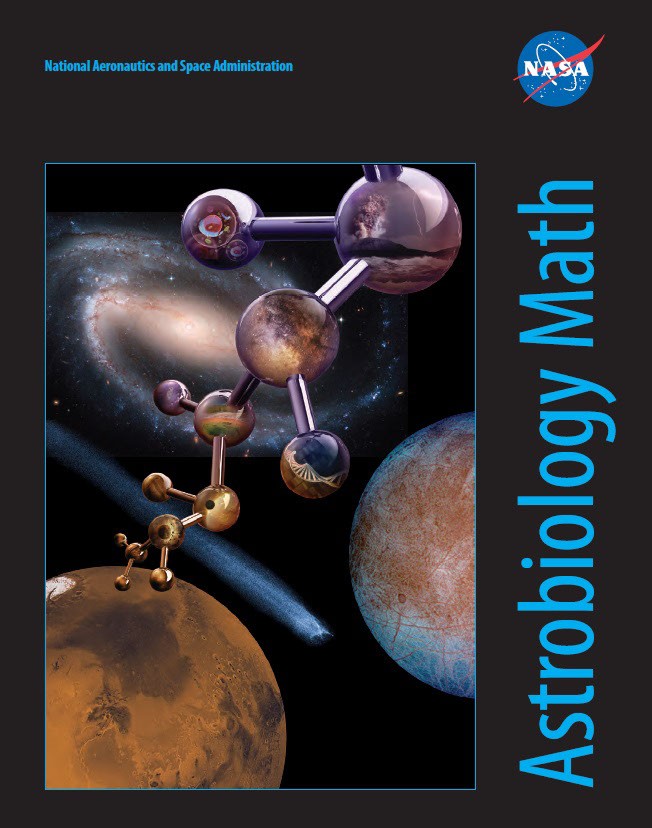
This problem set and educator’s guide from Space Math at NASA features 75 math problems for students grades 6-12+ introducing astrobiology concepts like the Drake Equation, habitability, and extra-solar planets. It is useful for engaging students in cross-curricular biology and astronomy mathematics by applying real-world space science to quantitative reasoning. Educators can integrate these exercises directly into lesson plans as supplemental activities, homework, or step-by-step group problem-solving challenges.
Credits: SpaceMath@NASA, Dr. Odenwald