|
Levels
|
- Introductory (K-5)
- Advanced (9-12+)
- Intermediate (6-8)
|
|
Material Type
|
|
|
Math Skills
|
- Data Analysis
- Arithmetic
- Percentages
- Rates
- Venn Diagrams
- Algebra I
|
|
Heliophysics Big Ideas
|
- Big Idea 1.2 – The Sun is active…
- Big Idea 2.2 – The Sun defines the space…
- Big Idea 3.1 – The Sun is made of churning plasma…
|
|
NGSS
|
- ESS1 – Earth’s Place in the Universe
- ESS2 – Earth’s Systems
- ESS3 – Earth and Human Activity
- ETS1 – Engineering Design
- PS1 – Matter and its Interactions
- PS3 – Energy
|
|
Heliophysics Topics
|
- Aurora
- Coronal Mass Ejection
- Energy
- Geomagnetic Storm
- Magnetic Reconnection
- Magnetosphere
- Radio Blackout
- Solar Cycle
- Solar Wind
- Solar Flare
- Space Weather
- Sunspot
|
|
Heliophysics Missions
|
- ACE
- ARTEMIS (THEMIS)
- Magnetospheric Multiscale (MMS)
- Parker Solar Probe
- PUNCH
- Solar and Heliospheric Observatory (SOHO)
- Solar Dynamics Observatory (SDO)
- Solar Orbiter
- STEREO A & B
- WIND
|
|
Material Cost per Learner
|
Free
|
|
Language
|
English
|
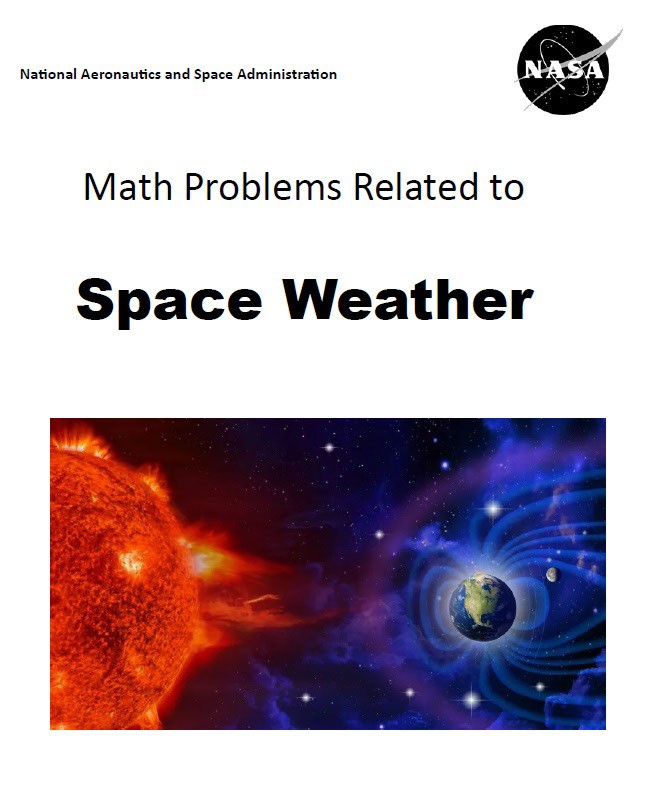
This problem set from Space Math at NASA provides 12 math exercises for estimating space weather storm frequencies and severities using historical data. For students grades K-12+, teachers can integrate these problems into statistics or Earth science units to help students analyze the probabilities and impacts of solar flares, auroras, and geomagnetic storms.
Credits: SpaceMath@NASA, Dr. Odenwald.