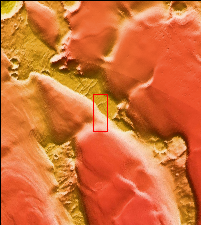
The pinkish orangey hues of Antarctica’s Danger Islands aren’t due to minerals in the rocks or lichens covering them. Instead, the color comes from the islands’ iconic black and white inhabitants.
Dense colonies of Adélie penguins on Antarctica’s islands and coasts produce large quantities of guano, extensive enough to be seen in satellite images. The color of the droppings can even provide clues into the penguins’ diet, since krill tints the guano pink, giving researchers a unique way to monitor penguin populations.
Analyzing three decades of Landsat images, scientists found that Adélie penguin diets vary around the Antarctic continent and are tied to sea ice conditions. In areas with less sea ice, the penguins have a krill-rich diet; in areas with more sea ice, they eat more fish, which is associated with healthier long-term population trends.
“Sea ice is such a hugely important factor in the Antarctic marine environment,” said Casey Youngflesh, an assistant professor at Clemson University in South Carolina who led the new study. “The structure of the region’s food web is changing in response.”
Adélie penguin colonies might be remote and often inaccessible, but the stark and treeless Antarctic environment provides a rare opportunity to study the entire population from space, Youngflesh said.
Previous research identified colonies based on satellite images of guano stains on rocky shores. Youngflesh and his colleagues visited the colonies to collect and analyze guano samples, allowing them to link specific color spectra observed by satellites to the balance of krill and fish in penguin diets.
Now, surveying more than 100 sites around the perimeter of Antarctica with Landsat images captured between 1984 and 2013, the scientists have connected penguin diets to the surrounding sea ice conditions during the breeding and nesting seasons.
Between November and February, colonies around the Antarctic Peninsula and West Antarctica, where temperatures were warmer and sea ice sparser, favored a krill-based diet. In East Antarctica, where sea ice cover was more extensive, colonies feasted on more fish—a higher-quality food resource and one that leads to better chick growth and survival. A given colony’s diet also changed year to year with shifting sea ice conditions.
Antarctic sea ice was relatively stable, or even increased in some regions, during the years of the study. However, since 2013 Antarctic sea ice has reached record lows, with decreasing sea ice predicted for the future. That could lead to Adélie penguins leaning more heavily on krill, Youngflesh said. But the demand for krill is increasing, he noted, due to fishing and rebounding populations of other predators like seals and whales.
The researchers are now developing computer models to use Landsat 8 and Landsat 9 data to continue tracking penguin diet and how the population responds to environmental change.
NASA Earth Observatory image by Michala Garrison, using Landsat data from the U.S. Geological Survey. Drone image by Thomas Sayre-McCord (Woods Hole Oceanographic Institution/MIT). Story by Kate Ramsayer.

- Clemson News (2026, July 7) Clemson researcher uses satellites to track what penguins eat from space. Accessed July 24, 2026.
- Landsat Project Science Support (2018, December 12) Determining Penguin Diet with Landsat (and Piles of Poo). Accessed July 24, 2026.
- NASA Earth Observatory (2017, June 13) Penguin Droppings Are Fertile Ground for Science. Accessed July 24, 2026.
- Youngflesh, C., et al. (2026) Space-based monitoring of penguin diet links sea ice, food webs, and population change. Current Biology, 36(14), 3707-3714.e5.