When organisms reproduce, like when a kangaroo has a litter of joeys or there’s a nest of baby birds or a bunch of seeds fall off of a tree, there will be differences among the offspring. Have you ever thought about what drives these differences? Even more, did you know that these kinds of differences can eventually lead to the process of biological evolution? Every living thing on Earth is made of one or many cells, with each cell containing the DNA of the organism. That DNA is like a recipe book. It tells the cells how to make the molecules that are needed to give that organism the characteristics that make it unique. One important thing about DNA is that when it gets copied by the cells so that the organism can reproduce, there are often mistakes in how the DNA gets copied. These little mistakes are called mutations. While some mutations can be bad for the organism, some mutations can actually be good. For instance, a mutation in an organism’s DNA might cause it to make a protein just a little different than other members of the same species. If that protein functions just a little better than the proteins of the other members, then this new characteristic might make this one organism slightly better suited to surviving in its environment. The process of slow and gradual change to the DNA of organisms, allowing them to better adapt to environments and/or to be better suited to changing environments, is what we call biological evolution. It’s the change in life over time. All of the accumulated differences in living things, from their colorations that might allow them to be camouflaged in a certain habitat to how they use their fins or their legs or their wings, not only allowed for living things on Earth to become so diverse and so beautiful, but they also allow life to adapt to changes in the environment.
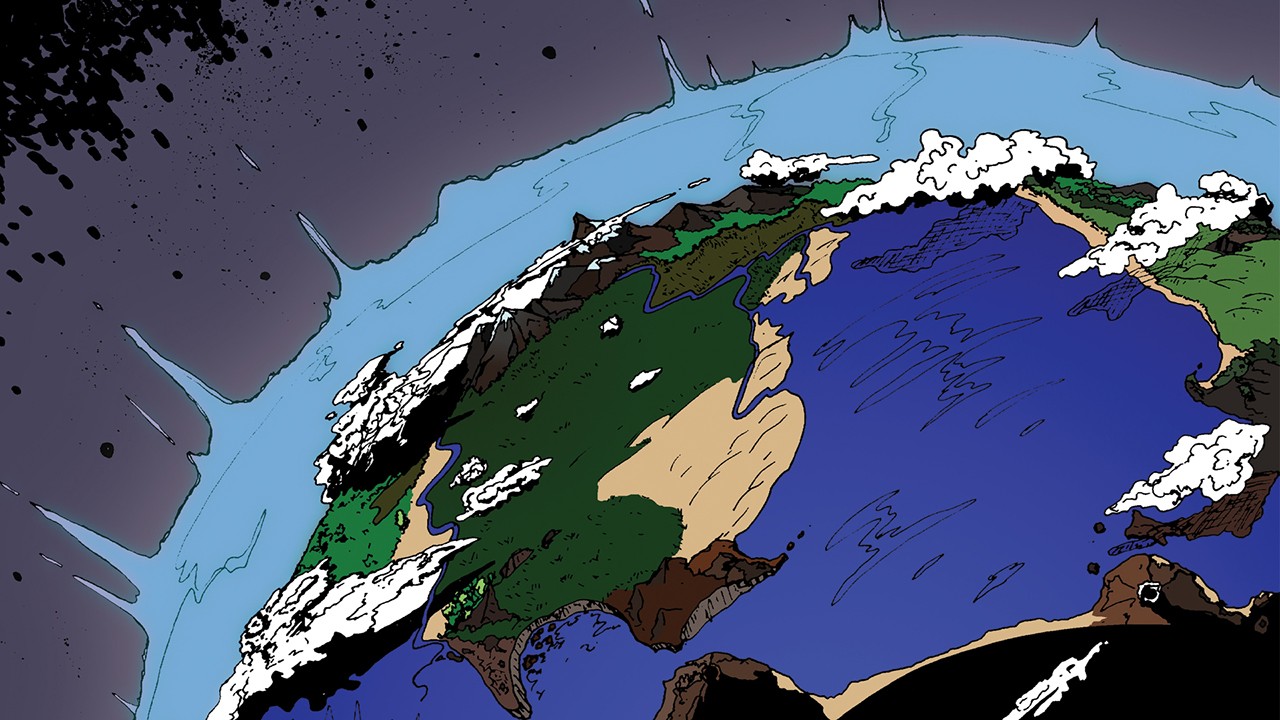
Nearly every environment at or close to the surface of Earth is full of life. From the driest deserts to the coldest glaciers in Antarctica, from the depths of the ocean to the top of mountains – life is there. That’s because life has had a very long time to adapt and evolve to all of these different kinds of environments on Earth. Certainly, if we were to travel back in time and visit the very early Earth, we might be able to find a time when life hadn’t yet adapted to living everywhere. The earliest life may have only been able to survive in a few places on the planet. But then, as the years started passing by and eventually billions of years passed by, life began adapting and spreading out to new environments.
Did you know that there have been times in the history of our planet when nearly every living things was killed and most species went extinct? These were times of great change for the planet and are known as mass extinctions. Mass extinctions appear to have been triggered by a variety of things, like impacts from space and large volcanic eruptions. These things caused the climate to change so fast that most living things couldn’t adapt to the new environments. However, even though mass extinctions caused the loss of lots of organisms, they also seem to be really important in causing new kinds of life to evolve on Earth. For instance, the event that caused the mass extinctions of the dinosaurs some 66 million years ago ended the great reign of the dinosaurs on Earth, but also allowed for the evolution of larger and more varied mammals that eventually led to us!
We now know that Earth and life have changed together through time. As living things started spreading out around Earth, the effects of their metabolisms and other living processes also started changing Earth. Understanding how life has evolved cannot be untangled from how Earth itself has changed. For instance, if we were to go back in time 3 billion years, we would see an Earth with a very different atmosphere than what it has today. Back then, oxygen wasn’t present as O2 in the atmosphere and organisms like us wouldn’t have been able to survive. However, around 2.5 billion years ago, living things on Earth started producing a lot of oxygen. So much so, that it started to change the chemistry of the oceans and the atmosphere. This caused a lot of living things that can’t survive in the presence of oxygen to die, but it also allowed for the evolution of whole new groups of living things that were able to breathe in oxygen, eventually leading to us breathing in and using oxygen. We can see the effects of this great change in life in the changes it caused in the oceans and atmosphere, as well as in the rocks. The Earth before this event, which is known as the Great Oxygenation Event ( GOE ), was a much different place than what it is now.
Looking back in the fossil record, we see that most of the history of life on Earth is dominated by microorganisms. For well over 3 billion years, microbial life was the only kind of life that would be found everywhere. It was only around 700 million years ago that the first multi-celled living things appear in the fossil record. Yet, in just those few hundred million years, multi-cellular life has adapted and evolved and spread around the entire planet. By studying the fossil record and the geological record as well as looking at how life is adapting and evolving to changes on Earth right now, we can better learn about how life and Earth have changed through time together. In every niche on planet Earth there is a deep and varied story of the evolution of the environment and of life.