May 13, 2026
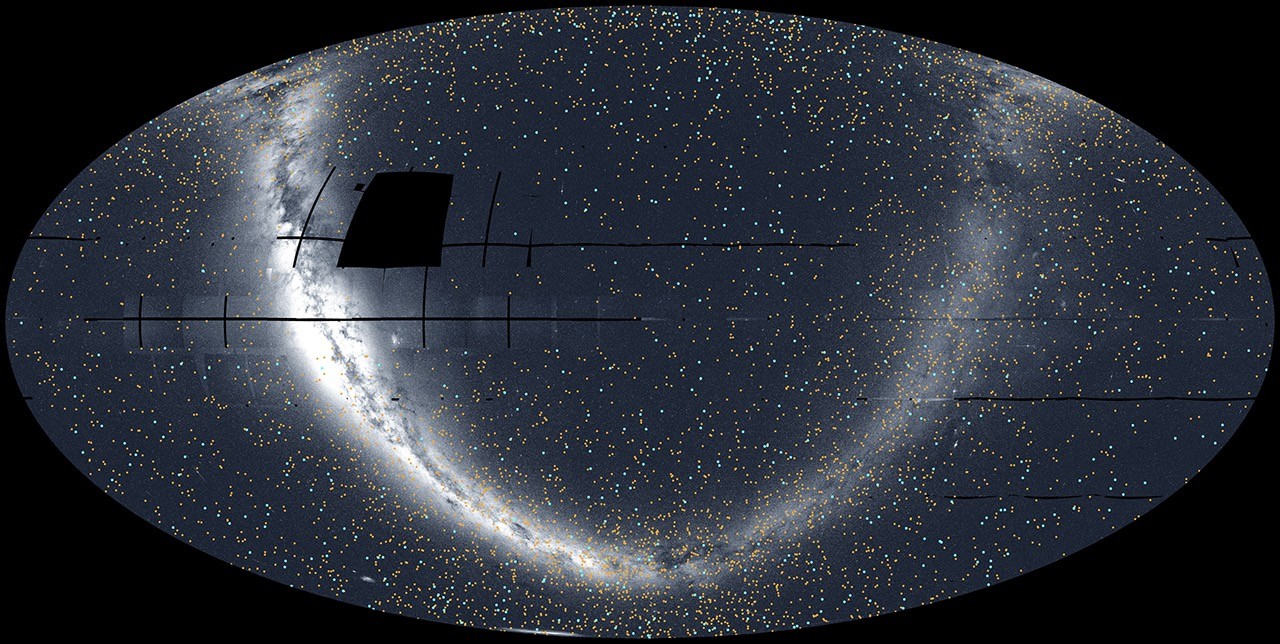
NASA’s TESS (Transiting Exoplanet Survey Satellite) has released its most complete view of the starry sky to date, filling in gaps from previous observations. Nearly 6,000 colored dots scattered across the image show the locations of either confirmed or candidate exoplanets — worlds beyond our solar system — identified by the mission as of September 2025 at the end of TESS’s second extended mission.
“Over the last eight years, TESS has become a fire hose of exoplanet science,” said Rebekah Hounsell, a TESS associate project scientist at the University of Maryland Baltimore County and NASA’s Goddard Space Flight Center in Greenbelt, Maryland. “It’s helped us find planets of all different sizes, from tiny Mercury-like ones to those larger than Jupiter. Some of them are even in the habitable zone, where liquid water might be possible on the surface, an important factor in our search for life beyond Earth.”
The TESS mission scans a wide swath of the sky, called a sector, for about a month at a time using its four cameras. These long stares allow the spacecraft to track the brightness changes of tens of thousands of stars, looking for variations in their light that might come from orbiting planets.
Researchers assembled an all-sky mosaic made of 96 sectors observed between April 2018, when TESS began its work, and September 2025.
The blue dots in the image mark the locations of nearly 700 confirmed planets, as of September 9. This menagerie includes worlds that may be covered by volcanoes, are being destroyed by their stars, or orbit two stars — experiencing double sunrises and sunsets each day. The orange dots represent more than 5,000 candidate planets that are awaiting verification.
To date, scientists have confirmed over 6,270 exoplanets using missions like TESS, NASA’s retired Kepler Space Telescope, and other facilities.
Also captured in the mosaic is the bright plane of our Milky Way galaxy, seen as a glowing arc through the center. The bright white ovals in the lower left are the Large and Small Magellanic Clouds. These satellite galaxies are located 160,000 and 200,000 light-years away, respectively.
“The more we dig into the large TESS dataset, especially using automated algorithms, the more surprises we find,” said Allison Youngblood, the TESS project scientist at NASA Goddard. “In addition to planets, TESS has helped us study rivers of young stars, observe dynamic galactic behavior, and monitor asteroids near Earth. As TESS fills in more of the night sky, there’s no knowing what it might see next.”
You could discover the next exoplanet! Join the Planet Hunters TESS citizen science project, and you’ll learn how to read light curves — plots of light data from distant stars — to find telltale signals from orbiting exoplanets.
By Jeanette Kazmierczak
NASA’s Goddard Space Flight Center, Greenbelt, Md.
Media Contact:
Claire Andreoli
301-286-1940
NASA’s Goddard Space Flight Center, Greenbelt, Md.