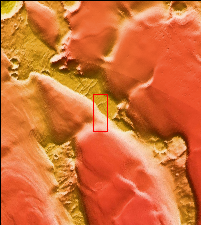
K-12 Art and the Cosmic Connection. These lessons (three-eight 60 minute lessons) use the elements of art including shape, line, color, texture, value, to have students make sense of images of planets, asteroids, comets and moons to hone their observation skills and inspire them to ask questions. Learners of all ages can create a beautiful piece of art while learning to recognize the geology on planetary surfaces. The lessons begin with what we know here on Earth and then uses that awareness to help students interpret features on distant objects in the solar system. JPL /California Institute of Technology. https://www.jpl.nasa.gov/edu/teach/activity/art-the-cosmic-connection/
3-5, 6-12 Rover Races. In this challenging and fun kinesthetic lesson (105 minutes), students begin to understand the challenges in communications that engineers face on NASA missions to Mars and other planetary surfaces. Students learn the limitations of operating a planetary rover and problem solving solutions by using this hands-on simulation. Aligned to standards in scientific and engineering practices, Rover Races help students learn to define problems, plan, coordinate and communicate. This activity for grades 3-12 engages students’ communication skills in a team environment. Arizona State University/NASA. http://marsed.asu.edu/lesson-plans-rover-races
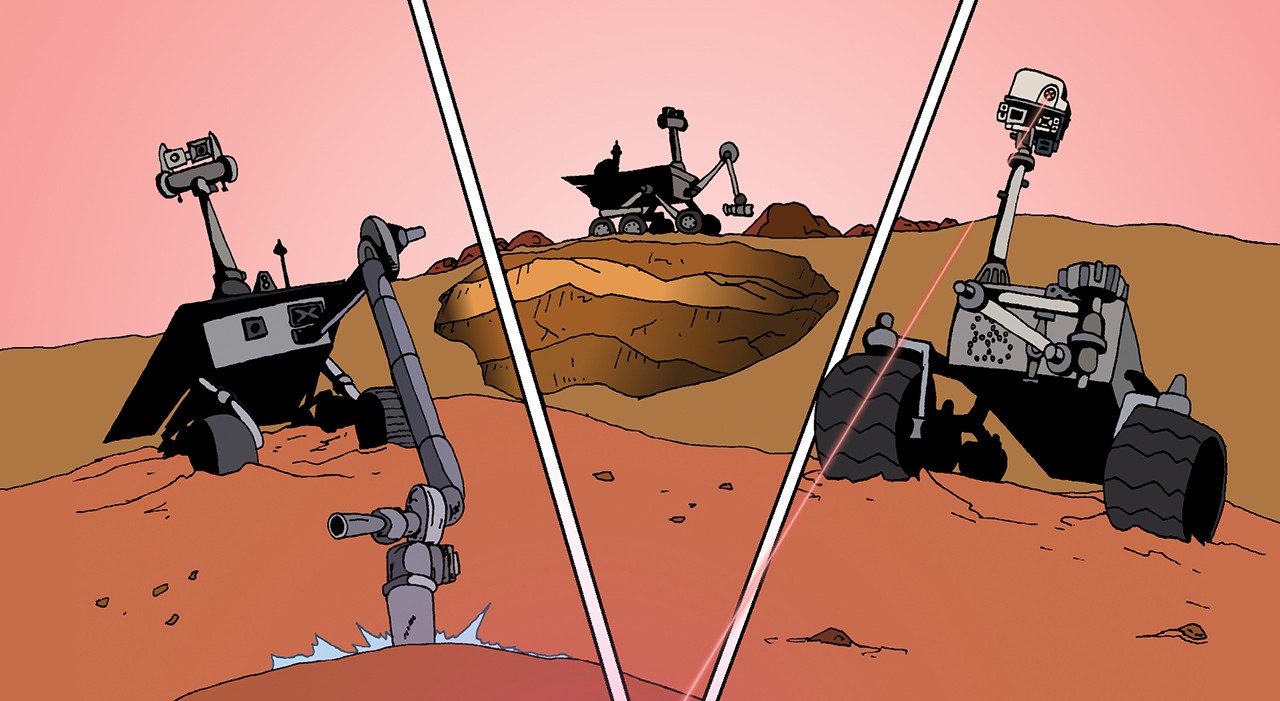
5-12 Astrobiology Graphic Histories. Issue 3: Missions to the Inner Solar System. These astrobiology related graphic books are ingenious and artfully created to tell the story of astrobiology in a whole new way. The complete series illustrates the backbone of astrobiology from extremophiles, to exploration within and beyond the solar system. This issue chronicles the multitude of missions that have explored the region of our solar system that rests inside the asteroid belt. NASA . https://astrobiology.nasa.gov/resources/graphic-histories/
5-12 Astrobiology Graphic Histories. Issue 4: Missions to the Outer Solar System. These astrobiology related graphic books are ingenious and artfully created to tell the story of astrobiology in a whole new way. The complete series illustrates the backbone of astrobiology from extremophiles, to exploration within and beyond the solar system. This issue features missions to locations in the outer Solar System. NASA . https://astrobiology.nasa.gov/resources/graphic-histories/
6-8 or 9-12 Question Mars. This three-hour standalone lesson is part of an exploration unit – Mars Student Imaging Project ( MSIP ). Students act as planetary geologists and learn about how to identify the geologic history of Mars with an eye toward its habitability. Students mirror the actions of planetary scientists as they follow their curiosity in order to create a researchable question that can be investigated through real scientific data/images. Arizona State University/NASA. http://marsed.asu.edu/msip-question-mars
6-12 Astrobiology Math. This collection of math problems provides an authentic glimpse of modern astrobiology science and engineering issues, often involving actual research data. Students explore concepts in astrobiology through calculations. Relevant topics include Lakes of Methane on Titan (page 53) and Another Look at Solar Energy (page 45). NASA . https://www.nasa.gov/pdf/637832main_Astrobiology_Math.pdf
6-12 (3-5 adaptable) Project Spectra! – Building a Fancy Spectroscope. In this activity, students build and decorate their own spectrographs using simple materials and holographic diffraction gratings. Spectrometry is a powerful tool in the search for life and the conditions for life in the solar system and beyond ( CLQ 7.1 ,7.3). After building the spectrographs, they observe the spectra of different light sources as a homework activity. University of Colorado, Boulder/NASA. http://lasp.colorado.edu/home/wp-content/uploads/2017/10/Building-a-Fancy-Spectrograph.pdf
6-12 (3-5 adaptable) Project Spectra! – Using a Fancy Spectroscope. In this activity, students use the spectrograph and homework from the activity “Building a Fancy Spectrograph.” Students look at various light sources and make conjectures about composition. Spectrometry is a powerful tool in the search for life and the conditions for life in the solar system and beyond ( CLQ 7.1, 7.3). University of Colorado, Boulder/NASA. http://lasp.colorado.edu/home/wp-content/uploads/2011/08/Using_Fancy_Spectrograph.pdf
6-12 (3-5 adaptable) Project Spectra! – A Spectral Mystery. In this lesson, students use the spectrograph from the “Building a Fancy Spectrograph” lesson to gather data about light sources. Using the data they’ve collected, students are able to make comparisons between different light sources and make conjectures about the composition of a mystery light source. Spectrometry is a powerful tool in the search for life and the conditions for life in the solar system and beyond ( CLQ 7.1, 7.3). University of Colorado, Boulder/NASA. http://lasp.colorado.edu/home/wp-content/uploads/2011/08/A_Spectral_Mystery.pdf
6-12 (3-5 adaptable) Project Spectra! – Designing and Open Spectrograph. In this two-class lesson, students build an open spectrograph to calculate the angle the light is transmitted through a holographic diffraction grating. After finding the desired angles, the students design their own spectrograph using the information learned. Spectrometry is a powerful tool in the search for life and the conditions for life in the solar system and beyond ( CLQ 7.1, 7.3). University of Colorado, Boulder/NASA. http://lasp.colorado.edu/home/wp-content/uploads/2017/10/Designing-an-Open-Spectrograph.pdf
6-12 (3-5 adaptable) Project Spectra! – Marvelous Martian Mineralogy. In the Marvelous Martian Mineralogy lesson, students use reflectometers to determine which minerals are present (from a set of knowns) in a sample of Mars soil simulant. This rich activity can be done with data only, with ALTA ii reflectometers and real mineral samples or with computer simulation. Identifying minerals through spectrometry is a powerful tool in the search for life and the conditions for life in the solar system and beyond. University of Colorado, Boulder/NASA. http://lasp.colorado.edu/home/wp-content/uploads/2011/08/Marvelous_Martian_Mineralogy.pdf
6-12 (3-5 adaptable) Project Spectra! – Star Light, Star Bright? Finding Remote Atmospheres. In “Star Light Star Bright? Finding Remote Atmospheres,” students explore stellar occultation events to determine if an imaginary dwarf planet “Snorkzat” has an atmosphere. Characterizing planetary bodies through spectrometry is a powerful tool in the search for life and the conditions for life in the solar system and beyond. University of Colorado, Boulder/NASA. http://lasp.colorado.edu/home/wp-content/uploads/2011/10/starlight_starbright_teacher.pdf
6-12 (3-5 adaptable) Project Spectra! – Enceladus, I Barely Knew You. In “Enceladus, I Barely Knew You” students establish whether Saturn’s small moon Enceladus has an atmosphere, whether the atmosphere encircles the whole moon, and whether it contributed to Saturn’s E-ring. Through data analysis students hypothesize attributes of Enceladus, a planet that has evidence of a water ocean under its icy crust. Characterizing planetary bodies through spectrometry is a powerful tool in the search for life and the conditions for life in the solar system and beyond. University of Colorado, Boulder/NASA. http://lasp.colorado.edu/home/wp-content/uploads/2011/10/starlight_starbright_teacher.pdf
6-12 (3-5 adaptable) Project Spectra! – Planet Designer: What’s Trending Hot? In the activity (two 50-minute lessons) Planet Designer: “What’s Trending Hot?” students use a computer game format of a featureless planet to deduce what variables affect the temperature of the planet. They control the distance to the Sun, Albedo, Density, size and greenhouse gases. Using computer simulation is a powerful tool in the search for life and the conditions for life in the solar system and beyond. University of Colorado, Boulder/NASA. http://lasp.colorado.edu/home/wp-content/uploads/2013/06/TrendingHot_teacher_20130617.pdf
8-10 SpaceMath Problem 275: Water on the Moon! Students estimate the amount of water on the moon using data from Deep Impact/EPOXI and NASA ’s Moon Mineralogy Mapper experiment on the Chandrayaan-1 spacecraft. [Topics: geometry, spherical volumes and surface areas, scientific notation] https://spacemath.gsfc.nasa.gov/moon/6Page11.pdf
8-10 SpaceMath Problem 264: Water on Planetary Surfaces. Students work with watts and Joules to study melting ice. [Topics: unit conversion, rates] https://spacemath.gsfc.nasa.gov/astrob/Astro3.pdf
8-10 SpaceMath Problem 263: Ice or Water? Whether a planetary surface contains ice or liquid water depends on how much heat is available. Students explore the concepts of Specific heat and Latent Heat of Fusion to better understand and quantify the energy required for liquid water to exist under various conditions. [Topics: unit conversion, scientific notation] https://spacemath.gsfc.nasa.gov/astrob/Astro1.pdf
8-10 SpaceMath Problem 121: Ice on Mercury? Since the 1990’s, radio astronomers have mapped Mercury. An outstanding curiosity is that in the polar regions, some craters appear to have ‘anomalous reflectivity’ in the shadowed areas of these craters. One interpretation is that this is caused by subsurface ice. The MESSENGER spacecraft hopes to explore this issue in the next few years. In this activity, students measure the surface areas of these potential ice deposits and calculate the volume of water that they imply. [Topics: area of a circle; volume, density, unit conversion] https://spacemath.gsfc.nasa.gov/astrob/4Page23.pdf
9-12 SpaceMath Problem 338: Asteroids and Ice. Students calculate how much ice may be present on the asteroid 24-Themis based on recent discoveries by NASA [Topics: mass=density x volume; volume of a spherical shell] https://spacemath.gsfc.nasa.gov/astrob/6Page154.pdf
9-12 Mission: Find Life. These brief video clips (8) are from The Mission: Find Life! exhibit at the Pacific Science Center in Seattle, WA. They show how astrobiologists search for life elsewhere in the Universe, studying extreme environments to understand the potential habitability of extraterrestrial environments, and examining how life might arise on planets orbiting stars different from our Sun. The exhibit features research at the Virtual Planetary Laboratory and ran March 18-September 4, 2017. VPL . https://www.youtube.com/playlist?list=PLaKWGoQCqpVDiJl9NBwJ4E7Nwf3tn-yzB
9-12 (6-8 adaptable) Project Spectra! – Designing a Spectroscopy Mission. In this project (3-5 weeks), students find and calculate the angle that light is transmitted through a holographic diffraction grating using trigonometry. After finding this angle, the students build their own spectrographs in groups and research and design a ground or space-based mission using their creation. Spectrometry is a powerful tool in the search for life and the conditions for life in the solar system and beyond ( CLQ 7.1, 7.3). University of Colorado, Boulder/NASA. http://lasp.colorado.edu/home/wp-content/uploads/2017/10/Designing-a-Spectroscopy-Mission.pdf
9-12 Modeling Hot and Cold Planets Activities A-C. These three activities (five-eight 45 minute lessons) can be used together or separate. There is a real world scenario to consider prior to these activities which focuses on the planning for a future Mars base. Students then experiment with both physical and computer modeling of planetary surfaces. Through the experiment, students discover many factors that affect the surface temperature of a planet and habitability. NASA . https://icp.giss.nasa.gov/education/modules/eccm/eccm_student_2.pdf#page=3
10-12 SpaceMath Problem 332: Hubble: The Changing Atmosphere of Pluto. Based on a recent press release, students determine the aphelion and perihelion of Pluto’s elliptical orbit using the properties of ellipses, then calculate the temperature of Pluto at these distances to estimate the thickness of Pluto’s atmosphere and its changes during its orbit around the sun. [Topics: properties of ellipses; evaluating an algebraic function] https://spacemath.gsfc.nasa.gov/astrob/6Page142.pdf