Many of us have wondered whether or not there could be other living things out there in the universe. Do you think we could find livings things on another planet, on a moon, or maybe even somewhere else? And, maybe a more important question, how might we find that life if it exists?
The first and maybe simplest answer would be to just look with a good camera or even our eyes and if we see a big alien with legs walking about or one with wings flying around, then we know we’ve found it. But what if the life on another planet is all microbial and not easy to find? Or, what if life on another world has now gone extinct? We can still use the tools of science to try to figure out if there are or were living things there.
Often in our daily lives we can find signs of life and know that a plant or an animal was present without really seeing it. A bird’s feather, some dog poop, dandelion seeds flying through the air, and a person’s footprints leftover in some mud are all signs of living things. Being able to find such signs is so important for astrobiology that we even have a word to describe them: we call these kinds of things “biosignatures”. A biosignature is any characteristic, element, molecule, substance, or feature that can be used as evidence for past or present life. It also needs to be something that can’t be made without the presence of life. It can be something like a leaf or a feather, but could also be fossils stored away in the rocks, organic molecules made by life, and even differences in the chemistry of an atmosphere or a body of water.
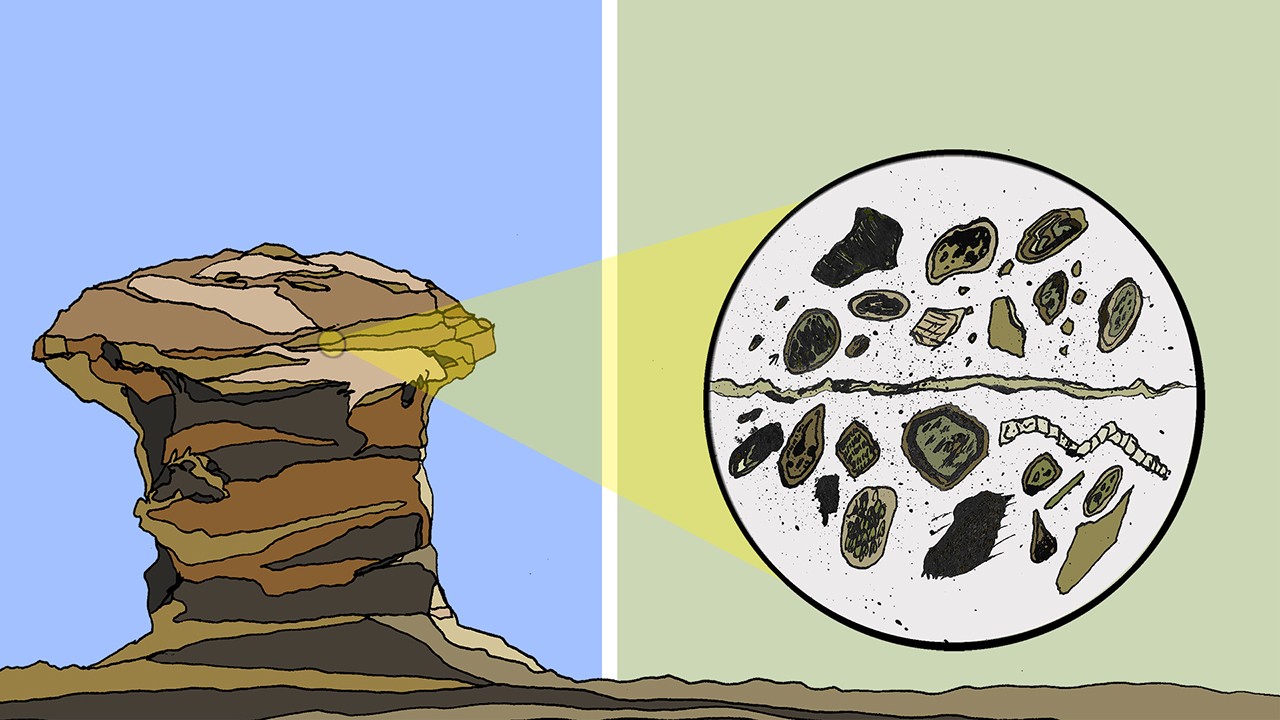
A morphological biosignature is one that we can tell was made from life based on its shape and size. The word “morphology” comes from the Ancient Greek words “morphé” (for “form”) and “lógos” (for “study” or “research”). So, morphology is really about studying the form of living things, and a morphological biosignature is one that’s a formation or structure leftover from living things. For instance, microorganisms living together in goopy microbial mats in shallow waters can create layered structures of minerals called stromatolites. There are microbial mats that are doing this today and there are fossilized versions of microbial mats from billions of years ago. If we were to go exploring on another world like Mars and found layered minerals from stromatolites in a rock, then that might be a biosignature. There are a bunch of morphological biosignatures that we might consider, including various types of fossils, etchings or layering in rocks, and even direct observations of cells or active living things.
Chemical biosignatures include a huge range of possible ways that life can leave its mark within the chemistry of rocks, bodies of water, and even atmospheres. For instance, biological macromolecules such as lipids, carbohydrates, nucleic acids, and proteins might all be used as biosignatures. Looking on alien worlds for DNA and RNA might be a little too Earth-centric, since we’re really not sure if alien life would use the same information storage molecules as us, but if we find those or other nucleic acids on an alien worlds then they could be important for us to consider as possible signs of life. We could also look for the kinds of lipids (fats) that are used to make up the membranes of living cells. On Earth, leftover lipids from life that existed long ago has allowed some scientists to piece together the kinds of organisms that were alive in certain places long before we humans were around.
It turns out that many molecules have two or more versions, based on how the chemical bonds form inside of them. We call these versions “chiral”. Chiral comes from the Greek word for “hand”. This is because chiral molecules are mirror images of each other, just like your hands. Your left hand and right hand are mirror images of each other; they have the same shape and structure, but if you lay your left hand on top of your right hand you can see that they are obviously different (the thumbs stick out in opposite directions). Our studies of non-living materials both on Earth and from asteroids and comets shows us that non-living things tend to have an equal mix of left-handed and right-handed chiral molecules. But all living things on our planet prefer one or the other when making biological molecules. Inside of your cells, all of the amino acids in your proteins are of the left-handed form (we call them “L” form, from the Latin word “Laevo” (on the left)), while all of your simple sugars inside of your body are of the right-handed form (we call them “D” form, from the Latin word “Dexter” (on the right)). Although life here on Earth is our only example of life so far, it’s possible that alien life would also pick either the L or the D form for its organic molecules, and this is something we can search for as a chemical biosignature.
Another chemical biosignature is the ratio of isotopes of chemical elements. An isotope of an element is the same element, but with a different number of neutrons in the nucleus. For instance, carbon-12 and carbon-14 are both carbon atoms, but carbon-12 has 6 neutrons and carbon-14 has 8 neutrons. It turns out that life as we know it really prefers using lighter isotopes of chemical elements (those with less neutrons). When an organism is catalyzing a chemical reaction, more energy can be used for metabolism and growth if the organism uses molecules in the reaction that have lighter isotopes. We’ve discovered that we can use measurements of the ratios of the lighter isotopes to the heavier isotopes within samples from nature as biosignatures.
What if we can’t get to the surface of a planet or moon to study the rocks there? For instance, what kinds of biosignatures might we look for on exoplanets? Using our telescopes on the Earth and in orbit of our planet, we can now look at the atmospheres of exoplanets to see what kinds of gas molecules are abundant there. One thing we look for, are gases that might be signs of life. For instance, early in our planet’s history our atmosphere didn’t have any of the oxygen that we breathe as O2\. Just how plants breathe in CO2 and breathe out O2 today, living things on Earth breathing out O2 are responsible for all of that oxygen we have in our atmosphere. So, it’s possible that oxygen or another gas used by life in an atmosphere might be a biosignature.
What if there are other forms of life out there in the universe that have developed civilizations and technology? The same way that we’ve been beaming our television and radio waves into space for over a century, maybe some intelligent life out there has been transmitting messages into space as well. If we were to receive these messages with our radio telescopes we might be able to use them as a type of biosignature called a technosignature (one that shows us that technological life made it). Looking for such technosignatures is part of something called SETI , or the Search for Extraterrestrial Intelligence. Not only does work in SETI involve listening for radio waves, but also considers many other ways that an intelligent alien civilization may be detectable. That includes looking for gas molecules in an exoplanet atmosphere that indicate industrial activity, looking for emissions of light from traveling spacecraft, and looking for signs that a civilization is advancing to a point where they are consuming energy from stars. That might sound like science fiction, but some scientists are considering how we might observe giant arrays of solar panels or other, perhaps way more advance, technologies that are collecting energy from a star.
Our continued efforts to study life here on Earth and learn about the kinds of biosignatures that life leaves behind will help us as we keep asking ourselves if we’re alone in the universe and whether or not we might find signs of alien life. Finding stromatolites in ancient rocks on Mars, measuring isotope ratios that signify life in a lake on the moon Titan, detecting what could be biological activity in gas compositions on exoplanets, or receiving a message from an extraterrestrial civilization would be monumental discoveries for all of us. However, if we do find potential biosignatures from alien life, we’ll certainly want to do the best job we can in making sure it’s a real biosignature and not something created abiotically.